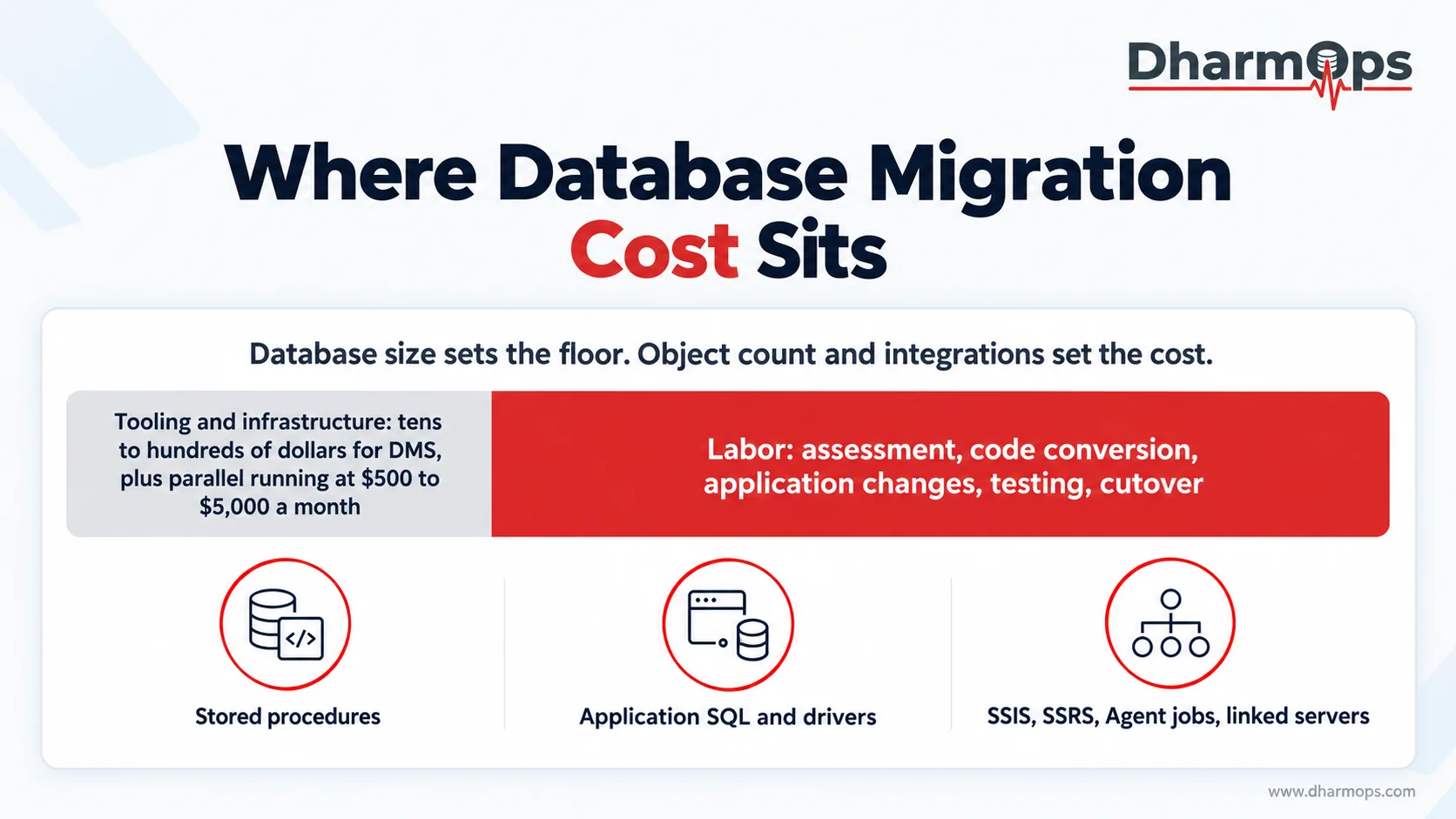
A database migration costs from about $5,000 for a small database to $250,000 or more for an enterprise system, and database size is the weakest predictor of where a project lands. Fastware, Fujitsu's PostgreSQL team, says a project sized on database size alone will be underestimated, usually by a wide margin. The effort sits in stored procedures, application code, and the integrations around the database.
The pressure to budget this well is higher in 2026. AWS charges RDS Extended Support per vCPU-hour once an engine version leaves standard support, and the rate doubles in year three. Microsoft ended extended support for SQL Server 2016 in July 2026. Staying put now has a monthly price.
Published data migration cost estimates run from $5,000 for smaller engagements to $250,000 and above, which is too wide to plan with. This guide shows what drives that spread, where the budget goes by phase, and how to build an estimate for your own system, with worked numbers along the way.
Want a straight answer for your specific setup? Book a 30-min diagnostic →
How much does a database migration cost?
Published guides quote by scale. Perimattic's 2026 guide gives these US dollar ranges and says estimates move up 20 to 50 percent when complexity or compliance issues appear:
| Scale | Typical cost |
|---|---|
| Small database migration | $5,000 to $15,000 |
| Medium system migration | $20,000 to $60,000 |
| Enterprise data migration | $75,000 to $250,000+ |
A UK guide from Suffescom prices cloud database moves at £5,000 to £15,000 for small businesses, £15,000 to £50,000 for mid-sized companies, and £50,000 to £100,000+ for large enterprises. The two guides agree on the shape: small projects in the low five figures, enterprise projects in six.
Read these as benchmarks, not quotes. Two databases of the same size can land in different rows once their code and integrations are counted.
Engine pair moves the number as much as scale. The same Suffescom guide lists SQL Server migrations at £15,000 to £75,000+ and Oracle at £30,000 to £200,000+.
Labor is the biggest line, and rates vary. DataFlowMapper cites $100 to $300+ per hour for external consultants, and AZ Big Media puts senior DBA time at $150 to $200 per hour. Ispirer cites a lower average of $67 per hour for data migration consultants.
Why does database migration cost matter more in 2026?
Waiting used to cost nothing. In 2026 it carries a bill on two platforms.
RDS Extended Support
AWS bills Extended Support at $0.10 per vCPU-hour in years one and two and $0.20 in year three, on top of the instance price. Exact dates depend on the engine version. Take ten 8-vCPU instances still on an old engine. That is 80 vCPUs for 730 hours a month, about $5,840 a month or $70,000 a year. In year three the same fleet costs about $140,000 a year.
SQL Server 2016
Microsoft ended extended support for SQL Server 2016 in July 2026. Extended Security Updates now cover three yearly terms, through July 2029. They keep patches coming, but they leave the engine as it is, so the migration still has to happen.
What it does to the budget
Compare that fleet's $70,000 a year with the ranges above. A same-engine version upgrade sits at the low end of them, so for many teams the surcharge is the cost of delay, not the cost of migrating.
Budgets also slip
Oracle's data migration white paper reports average overruns of 30 percent on cost and 41 percent on schedule, and AZ Big Media puts schedule slippage at the same 41 percent. That is why WildNetEdge recommends a 10 to 20 percent contingency buffer.
What drives database migration cost?
Size sets the floor. Eight factors set the rest.
1. Same engine or different engine
A same-engine move, such as a version upgrade or a shift to a managed service, is mostly data movement. A cross-engine move adds schema and code conversion, and that is the largest single cost in heterogeneous projects.
2. Procedural code volume
Stored procedures, functions, triggers, cursors, dynamic SQL, and MERGE statements each need conversion and testing. One licensing consultancy says PL/SQL converts only 50 to 70 percent automatically. The manual remainder is where the hours go.
3. Application and integration layer
Drivers, connection strings, ORMs, and embedded SQL all change. For SQL Server estates, SSIS packages, SSRS reports, SQL Agent jobs, and linked servers often outweigh the database itself. Fastware warns these dependencies can push back the cutover date, and schema converters do not read application repositories.
4. Downtime tolerance
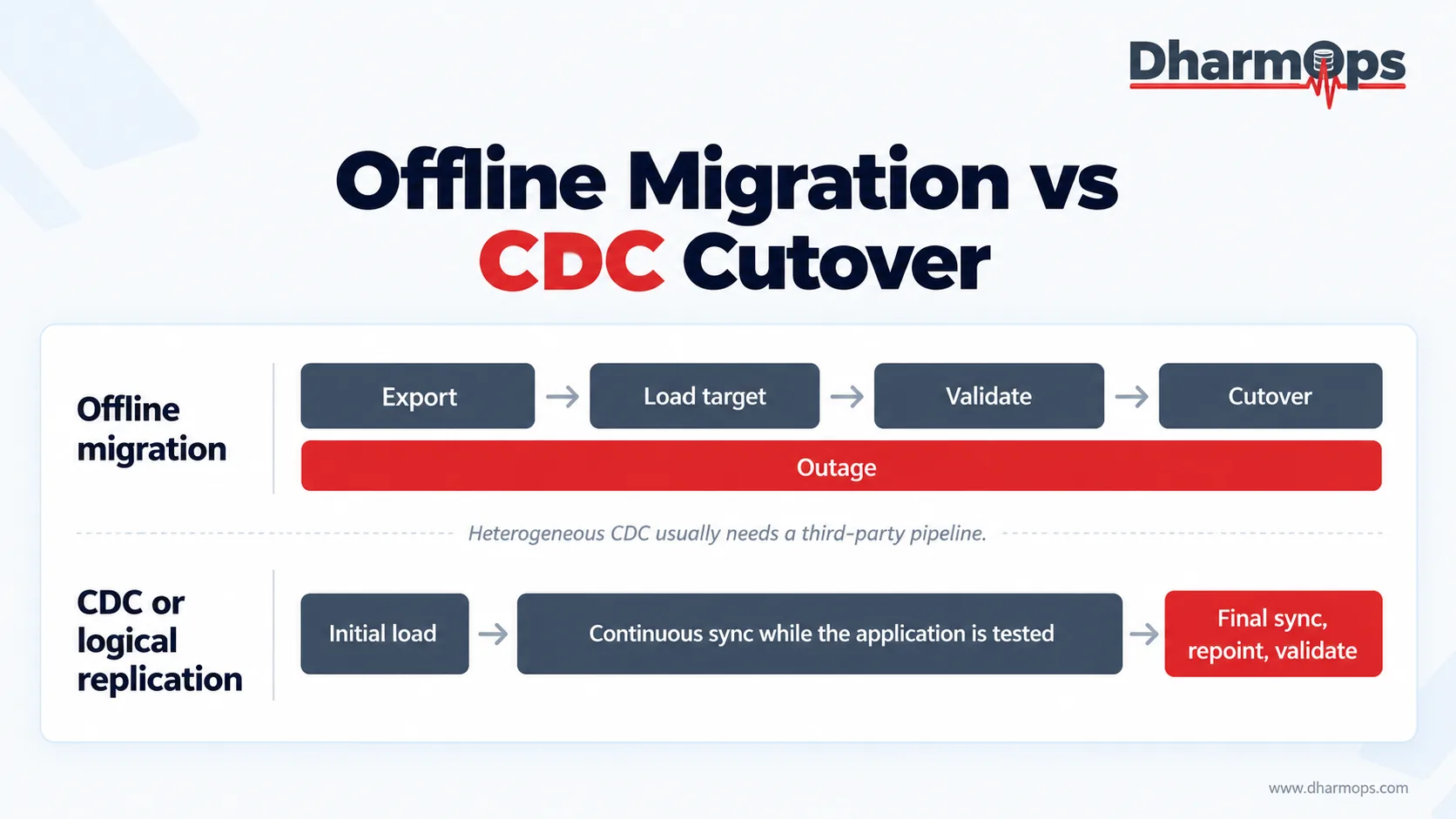
A long outage window allows a simple export and load. A short one forces change data capture (CDC) or logical replication, so the target stays current while the application is tested. In cross-engine moves, CDC usually needs a third-party pipeline, which is one more component to build and operate.
5. Data quality and transformation
Ispirer lists schema mismatches, code refactoring, and old, poorly documented records among the costs that surprise teams. Undocumented dependencies and non-standard data types make it worse.
6. Security and compliance
Replacing Windows Authentication, specifying encryption, and setting up audit logging all happen before cutover. Regulated industries also need documented evidence of data handling for GDPR, SOX, HIPAA, and PCI DSS.
7. Team skills
Experienced Oracle DBAs have to learn PostgreSQL, and developers need retraining on SQL dialect differences. Both take project time, even when no invoice says so.
8. Testing depth
Validation, performance testing, and rollback rehearsal scale with how many objects and applications depend on the database. More dependencies mean more test cycles before cutover.
Where does the database migration budget go by phase?
Suffescom's UK guide splits the budget into six phases:
| Phase | Share of budget |
|---|---|
| Assessment and planning | 10 to 15% |
| Infrastructure setup | 15 to 25% |
| Data migration | 25 to 40% |
| Testing and validation | 10 to 20% |
| Security and compliance | 10 to 15% |
| Post-migration optimization | 5 to 15% |
The ranges overlap, so pick one value per phase that totals 100 percent. Here is how a $100,000 budget for a mid-size system splits inside them: $12,000 for assessment, $20,000 for infrastructure, $30,000 for data migration, $15,000 for testing, $12,000 for security and compliance, and $11,000 for post-migration optimization.
Contingency sits on top. With a 10 to 20 percent buffer, that $100,000 plan carries $10,000 to $20,000 in reserve. It is the easiest line to cut and the hardest to replace once the project is running.
Fastware divides the technical work for a SQL Server to PostgreSQL move into five streams: schema and datatype conversion, T-SQL to PL/pgSQL code conversion, application-layer remediation, data migration and cutover, and validation against the original. Each stream becomes its own cost line.
What do migration tools and infrastructure cost?
Tooling is the cheapest part of the project, which surprises people. AWS DMS pricing is capacity-based, so you pay for what you run, and its schema conversion feature is billed only for storage. Here is what the common options cost:
| Tool | What it does | Cost |
|---|---|---|
| AWS DMS Schema Conversion | Converts schema and code | Only the S3 storage it uses |
| AWS DMS | Moves data, runs CDC | Hourly for the capacity you use |
| Google Database Migration Service | Moves data, runs CDC | No extra charge for same-engine moves, billed by GB for cross-engine |
| Ispirer | Commercial code conversion | About $495 a month (Light), $900 (Starter) |
| Ora2Pg, pgloader | Open source conversion and loading | No license fee, you pay for the labor |
AWS says all data transfer into DMS is free. Cross-AZ, cross-region, and internet transfer use standard AWS rates, which Ispirer lists at about $0.01, $0.02, and $0.09 per GB.
Ora2Pg can estimate the work for you. Its cost assessment scans every object and reports the effort in person-days.
Vendors claim 80 percent or more automation on code conversion, which cuts the labor, but treat that as a vendor position until your pilot confirms it. AZ Big Media's comparison puts manual projects at $150,000 to $600,000+ and 6 to 18 months, against $40,000 to $200,000 and 2 to 6 months with automation. That table is unsourced.
The larger infrastructure cost is running both systems at once during cutover. It lasts as long as the parallel run does, so it grows when the schedule slips.
Still Piecing This Together Yourself?
A senior engineer looks at your actual setup, not a generic checklist, and tells you exactly what's wrong and how to fix it.
Book a Discovery CallHow does cost change by migration path?
Same-engine and managed-service moves
Google Cloud does not charge extra for native same-engine migrations and bills cross-engine ones by gigabytes processed. Even when the tooling costs nothing, the project still carries assessment, testing, and cutover labor.
SQL Server to PostgreSQL
DBConvert's manual-effort table runs from 2 to 3 days for databases under 10 GB, to 2 to 4 weeks for 100 GB to 1 TB, to 4 to 8 weeks above 1 TB. Those are effort estimates for the manual part of the work. Object count and integrations still decide the timeline.
Oracle to PostgreSQL
Oracle projects cost more up front and pay back through licensing. One licensing consultancy's white paper lists Oracle Enterprise Edition at $47,500 per processor and says a conversion project typically runs about 15 to 30 percent of one year's Oracle support. Your actual renewal quote matters more than any list price.
Related: Oracle to PostgreSQL migration cost, data platform modernization
How do you estimate your own database migration cost?
A defensible estimate takes five steps:
- Inventory every object. Count stored procedures, functions, triggers, jobs, and the SQL embedded in application code. AWS Schema Conversion, Google's migration assessment tool, and Ora2Pg's cost assessment all estimate effort before you commit.
- Sort objects by difficulty. Plain tables and views convert cleanly. Procedures with cursors, dynamic SQL, or MERGE statements take manual work.
- Pilot one database. The pilot gives you real hours per object type. Say it shows 2 hours per procedure including testing. With 150 procedures at $150 an hour, that stream costs $45,000.
- Add the other lines: application changes, data cleaning, cutover, infrastructure, tooling, and post-migration support.
- Hold 10 to 20 percent as contingency, and add the parallel-running months you expect.
Human effort will dominate the total, so the pilot matters more than any rate card.
When bids arrive, ask each bidder whether the quote covers data cleaning, testing, cutover support, and post-migration tuning. A low quote that leaves them out only defers the cost.
What hidden costs and mistakes inflate the bill?
Estimates built from a quote miss the items below. Each one is avoidable.
Skipping the inventory
A schema converter reads the database. It does not find the report server, the scheduled jobs, or the application repositories that call into it. AZ Big Media notes that undiscovered objects and undocumented dependencies surface during execution, when they cost more to fix.
Underestimating parallel running
Source and target run side by side during cutover. AZ Big Media says parallel runs planned for four weeks frequently extend to three or four months.
Ignoring post-cutover performance
Fastware tells teams to expect performance regressions after conversion, and to plan PostgreSQL tuning during stabilization instead of treating regressions as evidence of failure.
Pricing downtime at zero
Divide yearly revenue by annual operating hours, then multiply by hours of downtime. In Ispirer's example, a business with $10 million in annual revenue that loses 4 hours loses $20,000, plus about $8,000 in productivity if 50 employees at $40 an hour sit idle. For large enterprises, AZ Big Media, citing Forbes, puts unplanned migration downtime above $9,000 per minute.
Treating data cleanup as an afterthought
Poorly documented legacy records cause transformation rework, and errors found in production cost far more than errors caught in testing. AZ Big Media's comparison reports fixes on 25 to 40 percent of objects for manual conversion against 5 to 12 percent with automation, and error rates of 15 to 30 percent per 1,000 objects against 2 to 8 percent. The table is unsourced, but its direction matches the rest of the research.
Forgetting compliance and license timing
Ispirer puts SOC 2 Type II audits at $20,000 to $150,000+ and PCI DSS at $5,000 to $200,000+ a year. Oracle savings arrive only when contracts end, so the first year can carry both sets of costs.
Get a Straight Answer, Not a Sales Pitch
Tell us what you're running into. We'll tell you directly what's causing it and what it takes to fix, before you sign anything.
Book a Discovery CallHow can you reduce database migration cost?
- Upgrade in place when the only goal is to leave extended support. A version upgrade costs far less than a cross-engine move.
- Retire dead code before conversion, so you do not pay to migrate objects nobody calls.
- Use CDC where the outage window is short, so application testing continues while the target stays current.
- Move in phases rather than one cutover, and rehearse rollback.
Related: database engineering
Why choose DharmOps for a database migration
DharmOps sizes a migration from your object inventory, not your database size. That means counting the stored procedures, application SQL, jobs, and integrations first, so the estimate reflects the work that decides the bill.
From there we scope conversion, cutover, and testing as separate lines, with rollback rehearsal included, and we tune the target after cutover. The result is a number you can defend to finance, built on hands-on, cross-platform database expertise.
Start with a diagnostic call. A senior engineer reviews your setup and tells you which of the cost drivers above apply to you.
Related: data platform modernization, insurance Oracle to PostgreSQL case study
A database migration is priced by what is inside the database and around it, not by how many gigabytes it holds. Object counts, procedural code, application SQL, integrations, and the outage window you can accept decide the budget. Tooling is a small line item. Labor is most of the bill.
The way to a number you can defend is an object inventory, a pilot on one database, and a contingency line of 10 to 20 percent. DharmOps works from your object inventory, not your database size. Start with a diagnostic call and we will scope the conversion, cutover, and testing work for your system.
Frequently Asked Questions
How much does it cost to migrate a database to the cloud?
Perimattic puts a small database migration at $5,000 to $15,000 and an enterprise one at $75,000 to $250,000+. A UK guide gives £5,000 to £15,000 for small businesses and £50,000 to £100,000+ for large enterprises. A same-engine move costs far less than a cross-engine move at the same size.
What is the difference between data migration and database migration?
Data migration moves data between systems, and data migration cost covers that movement. Database migration moves the whole database: schema, code, and data, often between engines. Its cost is higher because the code needs converting.
Why is Oracle to PostgreSQL more expensive than SQL Server to PostgreSQL?
Oracle estates carry more procedural code and tend to have more dependencies. One UK guide puts Oracle at £30,000 to £200,000+ against £15,000 to £75,000+ for SQL Server.
How much does AWS DMS cost?
AWS DMS pricing is capacity-based, so you pay hourly for what you run. All data transfer into DMS is free, and AWS Schema Conversion costs only the S3 storage it uses.
How long does a database migration take?
DBConvert's manual-effort estimates run from 2 to 3 days for databases under 10 GB to 4 to 8 weeks above 1 TB. Object count and integrations decide the real timeline.
Why do database migrations go over budget?
Work nobody inventoried: stored procedures, application SQL, and integrations that appear mid-project. Oracle's white paper reports average overruns of 30 percent on cost and 41 percent on schedule.
What is the biggest hidden cost in a database migration?
Work nobody inventoried comes first. Parallel running that stretches from weeks to months comes second.
Can a database migration have zero downtime?
CDC shortens the outage, but the final sync, application repointing, and validation still need a window.
Get a Straight Answer on Your Setup
Tell us what you're running into. We read every message personally and reply within 24 hours with times for a free call.