By Yash Amin, Founder and CEO · Published · Updated
How we replaced one-off pipelines at an e-commerce company with a self-service data platform
The problem wasn't a lack of data. It was the lack of a repeatable way to move, test and deploy it, so every request landed on one data team.
- Industry
- Retail and e-commerce
- Platform
- Modern analytical data platform
- Engagement
- Data platform modernization
- Our role
- Data platform engineering
Teams build on a standard path. Every request used to go through the data team.
Automated testing and deployment, which were manual before
Data problems caught by contracts and validation, not after reports broke
Pipeline health, freshness and lineage tracked, not investigated by hand
About the Client
A growing e-commerce organization where data drives customer experience, operations, reporting and its analytics and AI plans.
Its systems include a website and mobile app, ERP, CRM, payments, inventory and warehouse platforms, marketing tools, marketplace channels and customer support.
| Detail | Specifics |
|---|---|
| Industry and size | Retail and e-commerce, growing organization |
| Data environment | Website and mobile app, ERP, CRM, payments, inventory and warehouse, marketing, marketplaces and customer support |
| Platform | Modern analytical data platform |
| Team | A central data engineering team that built and maintained the pipelines for every request |
| State before engagement | Fragmented integrations, custom pipelines and manual workflows |
The Situation
As the organization grew, every new report, integration or data request meant the central data team had to build another custom pipeline.
Those workflows had grown out of scripts, scheduled jobs, APIs and manual steps. They were hard to standardize, hard to maintain and harder to scale, and the request backlog kept growing.
The business also wanted stronger analytics and AI. That needed a data foundation that was reliable, observable and repeatable first.
Challenges
Fragmented data
Business data sat across many operational systems with no consistent analytical foundation.
One-off pipelines
Each new requirement meant another custom integration, and the maintenance load grew with every one.
A growing backlog on one team
Engineering and business teams waited on the central data team for every new workflow.
Problems found late
Data quality issues and upstream schema changes surfaced after pipelines had run and reports were already affected.
Manual testing and deployment
Releases needed hands-on steps, and a failed pipeline took manual investigation to explain.
A data foundation not ready for AI
Analytics and AI plans depended on data that was reliable and accessible, and it was neither yet.
Diagnosis
The constraint was not the number of data sources. It was that no standard engineering path existed for building and running data workflows. Four causes sat behind it.
No standard way to build a pipeline
Scripts, scheduled jobs, APIs and manual steps had piled up over time. Each pipeline was built differently, so none could be reused.
No contract between producers and consumers
Upstream schema changes broke downstream workflows because nothing defined what a source had to deliver.
Validation and testing came after the fact
Limited data quality checks meant bad data moved through the pipeline before anyone saw it.
No visibility into workflows
When data changed unexpectedly, finding the cause meant reading scripts and asking the people who wrote them.
The organization didn't need more pipelines. It needed a repeatable platform and a path for building them the same way every time.
What We Did
Standardized data integration
Defined reusable patterns for APIs, databases, CDC, event streams, file ingestion and SaaS connectors. New sources now plug into an existing pattern instead of starting from scratch.
Built the pipeline foundation
Set up repeatable ETL and ELT patterns for ingestion, transformation and analytical workloads, landing in a central analytical warehouse that feeds curated business data products.
Introduced the Golden Path
Created one engineering workflow covering pipeline templates, data contracts, validation, automated testing, CI/CD and observability. A developer or business team follows it instead of raising a request.
Built reliability into the workflow
Data quality checks, orchestration, monitoring and documentation became steps in the path, not separate activities done after launch.
Architecture: Before and After
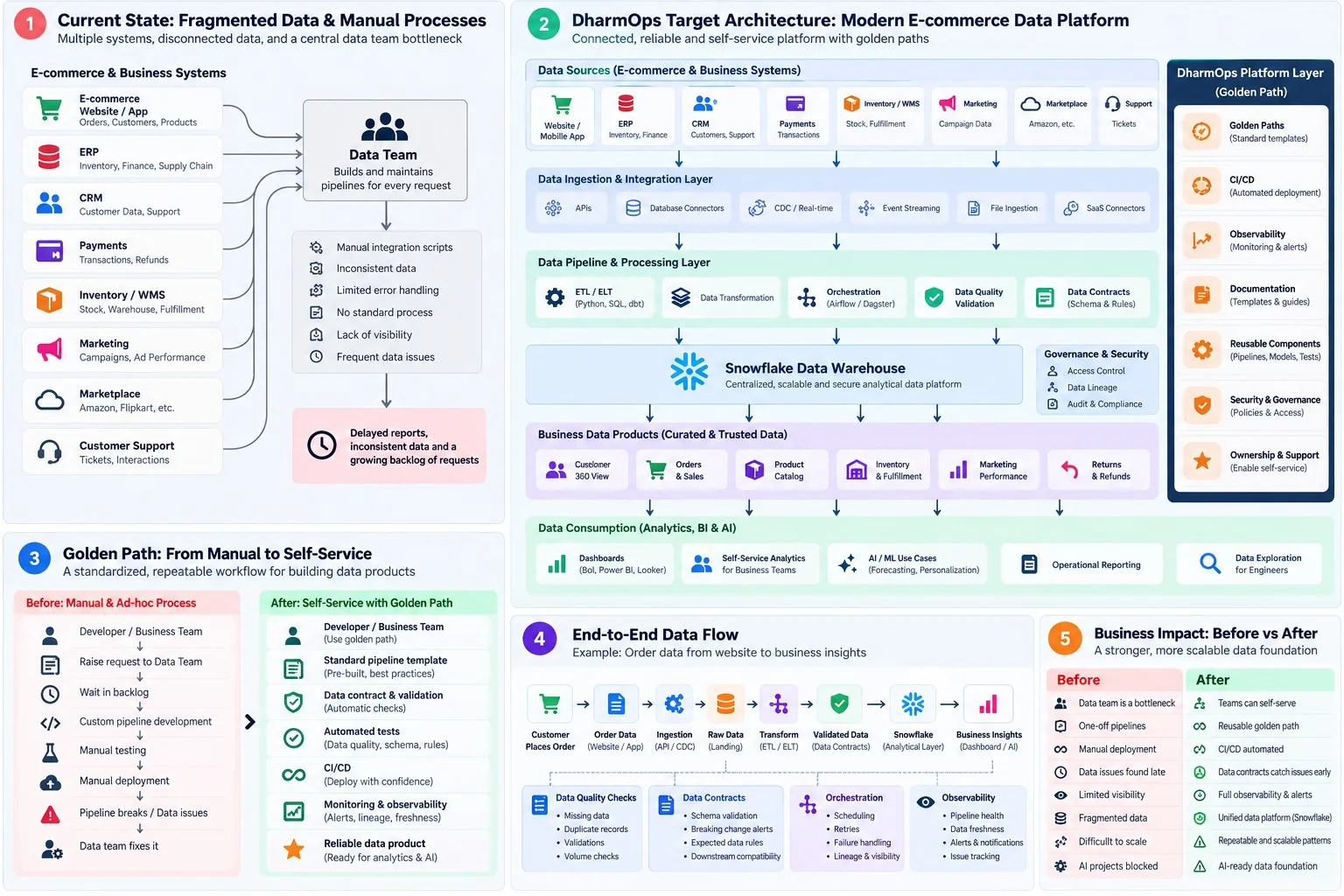
Swipe the diagram sideways to read it.
View diagram full sizeBefore
Business systems feed a central data team that builds and maintains every pipeline by hand. Custom integrations, inconsistent data and limited visibility pile up into a request backlog.
After
Standard ingestion, processing, quality controls and contracts feed one warehouse. Curated data products serve dashboards, self-service analytics and AI use cases through the Golden Path.
Implementation Timeline
Platform assessment
Mapped systems, pipelines, integrations, deployment processes, data quality issues, bottlenecks and ownership.
Golden Path design
Defined reusable patterns for ingestion, transformation, validation, testing, deployment, monitoring and documentation.
Pilot build
Applied the pattern to one representative data workflow: integration, transformation, validation, testing, deployment and monitoring.
Handover and documentation
Documented the platform and trained the engineering team to operate it.
Expansion
Extended the proven patterns to more data products and domains.
Before and After
| Step | Before | After |
|---|---|---|
| Data requests | Raised with the central data team | Followed through the standard self-service path |
| Pipeline development | Custom, one-off pipelines | Reusable Golden Path templates |
| Testing | Manual and inconsistent | Automated validation and testing |
| Deployment | Manual | CI/CD |
| Data quality | Issues found late | Contracts and validation catch them early |
| Visibility | Limited | Monitoring, lineage and alerts |
Results
| Metric | Before | After | Change |
|---|---|---|---|
| Data delivery | Waits on the central team | Standard engineering path | Self-service |
| Pipeline development | One-off | Reusable patterns | Repeatable |
| Deployment | Manual | CI/CD | Automated |
| Data quality | Detected late | Validation built into workflows | Caught earlier |
| Visibility | Limited | Observability and alerts | Tracked |
| AI readiness | Blocked by data cleanup | Governed analytical foundation | Ready to build on |
Tradeoffs and What We'd Do Differently
Start with the actual bottleneck
Begin with the constraint the organization is living with, not with a choice of tools.
Prove one Golden Path first
A single pilot workflow shows what works before the pattern is applied across every domain. It costs time up front and slows the first rollout.
Treat Golden Paths as products
A path only stays useful with an owner, documentation, support and regular improvement.
Fix the data foundation before scaling AI
Analytics and AI projects move faster once the underlying data is reliable, accessible and monitored.
Technology Stack
| Layer | Tool |
|---|---|
| Data engineering | Python, SQL, dbt |
| Integration | APIs, CDC, Kafka and event streaming, database and SaaS connectors |
| Orchestration | Airflow, Dagster |
| Data platform | Snowflake |
| Platform engineering | Docker, Kubernetes, Terraform |
| CI/CD | Automated testing, build and deployment |
| Operations | Logs, metrics, alerts, pipeline monitoring |
| Data quality | Schema, freshness, integrity and anomaly checks |
Data Platform Engineering Questions
What is a Golden Path in data platform engineering?
A Golden Path is one standard engineering workflow for building and running data pipelines. In this engagement it covered pipeline templates, data contracts, validation, automated testing, CI/CD and observability, so a developer or business team follows the path instead of raising a request with the central data team.
Why do custom data pipelines become a bottleneck?
Each new report or integration needed another custom pipeline built by one central team. Those pipelines grew out of scripts, scheduled jobs, APIs and manual steps, so they were hard to standardize, hard to maintain and impossible to reuse, and the request backlog kept growing.
What are data contracts and why do they matter?
A data contract defines what a source system must deliver. Without one, upstream schema changes broke downstream workflows because nothing stated what a source had to provide. Contracts plus validation catch those problems before pipelines run, not after reports are affected.
How do you roll out a Golden Path without disrupting teams?
Prove it on one representative workflow first: integration, transformation, validation, testing, deployment and monitoring. Once the pilot shows what works, extend the patterns to more data products and domains. The tradeoff is time up front and a slower first rollout.
Why fix the data foundation before scaling AI?
Analytics and AI plans depend on data that is reliable, accessible and monitored. Here, those plans were blocked by data cleanup until a governed analytical foundation with contracts, validation and observability was in place.
How do you implement data contracts?
Define what each source must deliver, then enforce it in the pipeline. Here, contracts, validation and automated testing became steps in the Golden Path, run through CI/CD. A source that changes its schema now fails a check before the pipeline runs, instead of breaking downstream reports afterward.
What does a self-serve data platform architecture include?
In this e-commerce platform: standard ingestion patterns for APIs, databases, CDC, event streams, file ingestion and SaaS connectors; ETL and ELT patterns landing in a central Snowflake warehouse; curated data products on top; Airflow or Dagster orchestration; and the Golden Path of templates, contracts, validation, CI/CD and observability that teams follow instead of raising requests.
Is your data team the bottleneck?
On a diagnostic call we walk through your current data landscape, pipeline bottlenecks and integration approach, and where a self-service path would remove the most requests.
Start with a Diagnostic Call