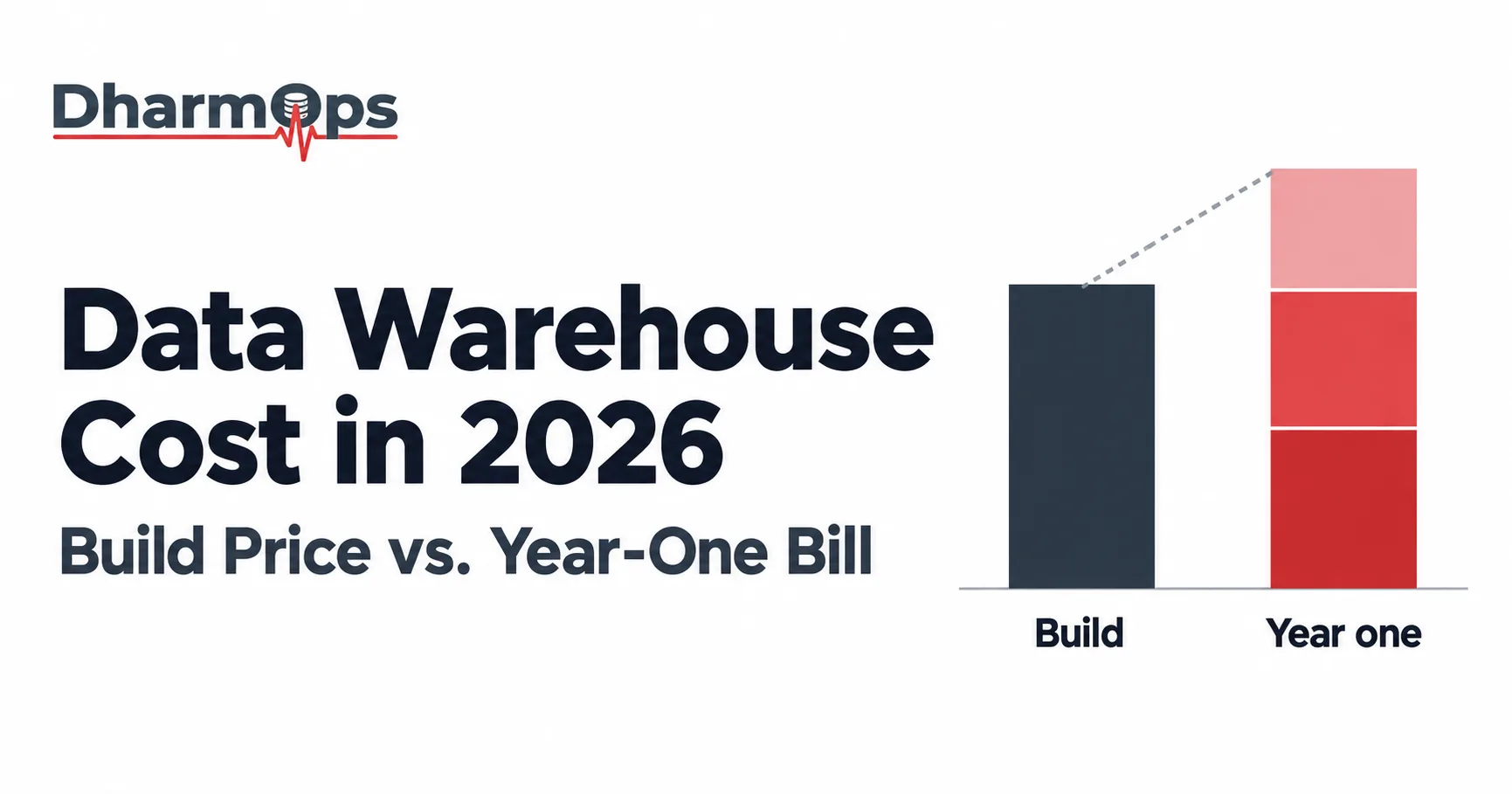
A data warehouse quote covers the build. The bill that catches teams out shows up around month four, when compute, ingestion tools and the people who run it arrive on separate invoices.
That second bill keeps growing. In Flexera's 2026 cloud survey, 85% of organizations call cloud spend a top challenge, and AI workloads just pushed wasted spend up for the first time in five years. People can cost more than the platform: a US database architect's median pay is $139,500.
Most cost guides give you one of those numbers, not both. A vendor selling one piece of the stack usually wrote them.
This guide gives you both, for small, mid-size and enterprise builds. You'll see what moves a quote, 2026 running costs on Snowflake, BigQuery, Databricks, Redshift and Fabric, three real budgets line by line, and a six-step way to estimate yours.
Written from hands-on, cross-platform database expertise. Every price links to its source.
Jump to: Cost by tier · Running cost by platform · Three real budgets · Estimate yours
Fewer than five data sources? See whether you need a warehouse at all →
Already holding a warehouse quote? Book a 30-minute discovery call →
How much does a data warehouse cost in 2026?
Most data warehouses cost $25K to $1M+ to build. Year one of running them costs about as much again, or more. Where you land depends on how many systems feed it, how fresh the data must be, and how regulated it is.
| Tier | Typical company | Data sources | Build cost | Year-one run cost (before staff) | Build time |
|---|---|---|---|---|---|
| Small | 20 to 150 people, SaaS or services | 3 to 8, mostly SaaS apps | $25K to $80K | $5K to $60K | 6 to 12 weeks |
| Mid-size | 150 to 1,000 people, ERP and CRM | 8 to 25, including 1 to 2 ERPs | $80K to $300K | $60K to $250K | 3 to 6 months |
| Enterprise | 1,000+ people, regulated, legacy systems | 25+, on-premises and cloud | $300K to $1M+ | $250K to $1M+ | 6 to 12+ months |
What counts as "build" and what counts as "run"
The build is a one-off project: discovery, architecture, pipelines, modeling, dashboards, testing and handover.
The run is everything that bills you after go-live: compute, storage, ingestion, transformation, BI licenses and monitoring. It also includes the people who keep it working, which most quotes leave out.
The five layers you pay for
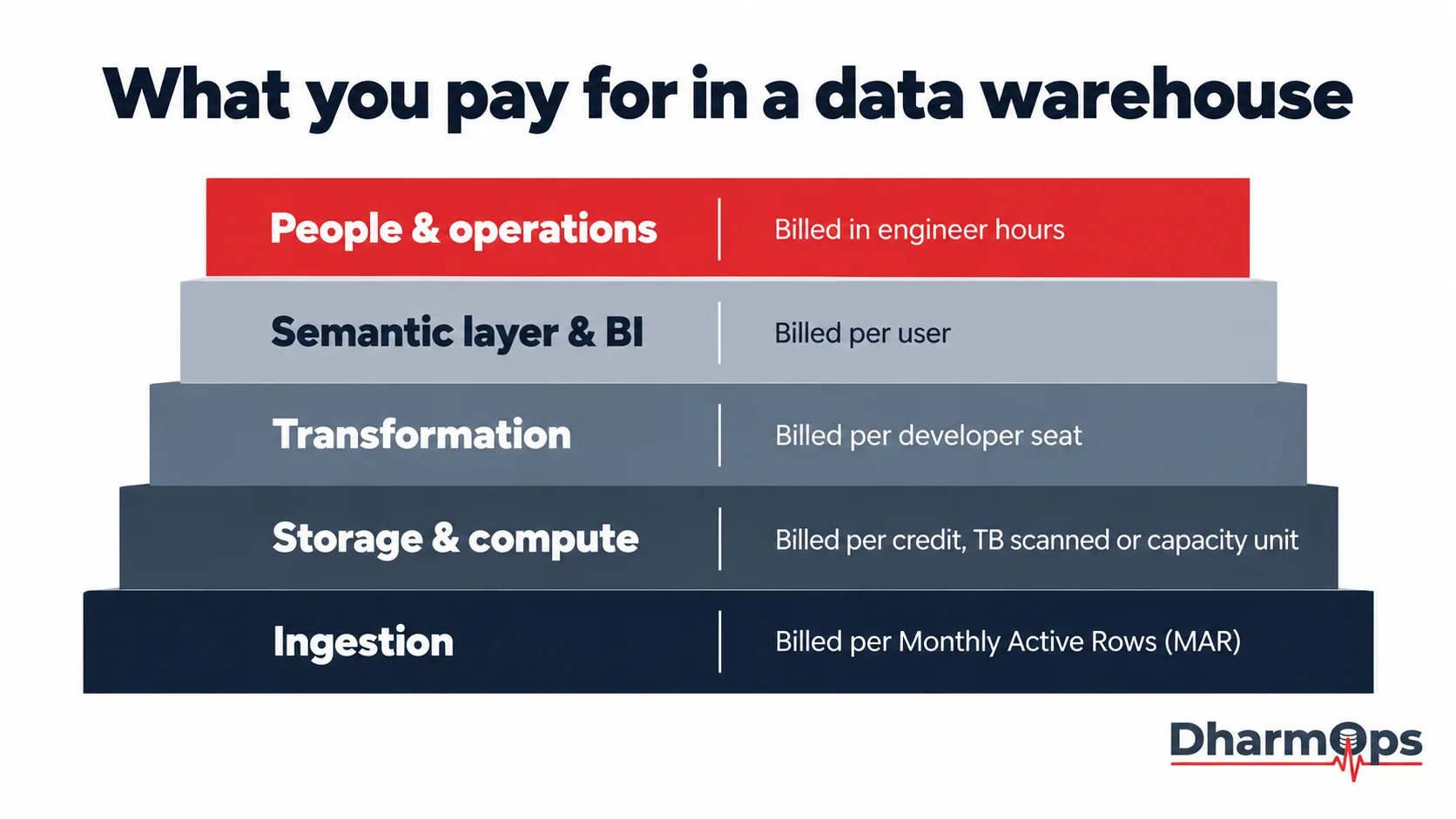
Every warehouse has the same five layers, and each bills in a different unit. That's why no single invoice shows the total.
- Ingestion moves data in from your apps. Fivetran, for example, bills per monthly active row.
- Storage and compute is the warehouse itself, billed per credit, terabyte scanned or capacity unit.
- Transformation turns raw tables into clean models, often billed per developer seat.
- Semantic layer and BI is where people see the numbers, usually billed per user.
- People and operations is the engineer time that keeps it all running.
Why the build quote isn't the number to budget
Everyone negotiates the build quote. The running cost keeps arriving, and within a year it usually matches or passes the build.
Running costs catch up with the build by month 12
In the three example budgets later in this guide, year one costs as much as the build or more:
- A 60-person SaaS company: $45K to build, $45K in year one.
- A 400-person distributor: $180K to build, $203K in year one.
- A 2,000-person insurer: $650K to build, $770K in year one.
In all three, people are the largest running cost, not the platform.
What changed in 2026
Microsoft Fabric became a real option. It bills for a capacity size whether you use it or not, unless you pause it.
AI features now bill on top of compute. Snowflake moved its AI features onto a separate credit schedule in April 2026. If models or agents will read from the warehouse, plan that load with the rest; our AI operations work covers it.
Open table formats went mainstream. Snowflake-managed Apache Iceberg storage and Redshift writes to Iceberg arrived in mid-2026, making cheap object storage a practical choice.
Ingestion pricing got stricter. Fivetran now counts deleted rows toward paid rows and adds a $5 minimum per low-volume connection (Fivetran).
Why data warehouse quotes vary 5 to 10x
Two honest firms can quote the same company $60K and $400K. They're pricing different answers to seven questions, and most of the answers sit on your side of the table.
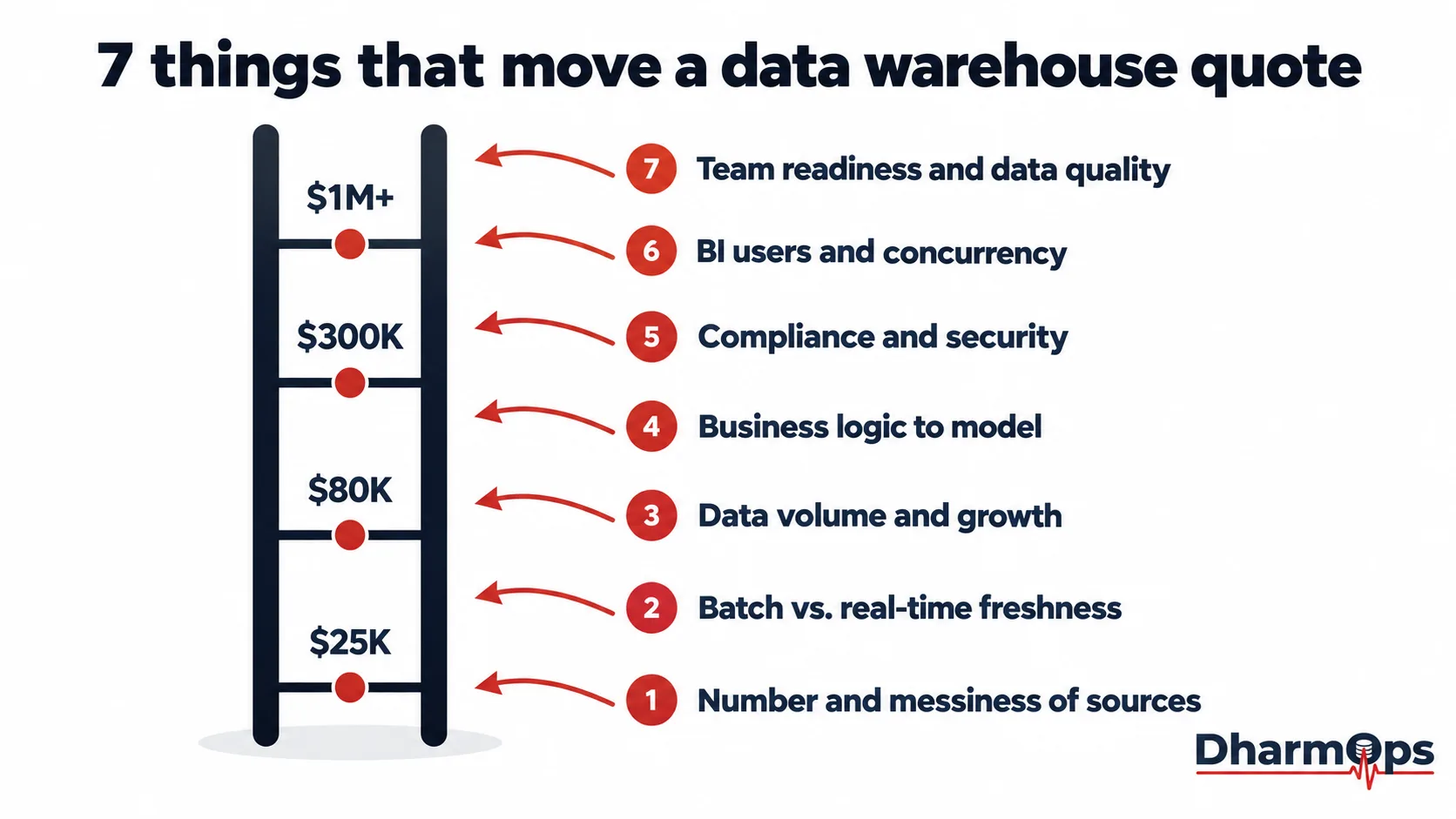
1. How many sources, and how messy they are
Sources drive cost more than anything else. A clean SaaS API like Stripe connects in hours. A custom database or old ERP can take weeks.
Why one ERP can cost more than ten SaaS connectors
ERPs like NetSuite, Dynamics 365 or SAP carry custom fields, undocumented rules and years of history to load and check. One often takes more time than a dozen standard connectors.
2. Batch vs. near-real-time freshness
Nightly loads are cheap. Loading every few minutes needs change data capture (CDC), streaming and more monitoring. Pay for real time only where someone acts faster than daily.
3. Data volume and growth rate
Storage is cheap at small scale. At large scale, history loads, backfills and query costs grow with every terabyte. Plan for your size in 24 months.
4. How much business logic has to be modeled
"Revenue" can mean five things across finance, sales and product. Every definition you must agree on and model adds days.
5. Compliance and security
HIPAA, SOC 2, GDPR or PCI add access controls, masking, audit logs and documentation. Regulated builds take noticeably longer.
6. Number of BI users and concurrency
Ten analysts and five hundred dashboard viewers need different setups. More users means more licenses and more compute.
7. Your team's readiness and data quality
If nobody owns the source systems, or the data is full of gaps, the build team cleans it. That rarely shows in the first quote, and it's the most common reason a fixed price grows.
Data warehouse implementation cost, phase by phase
A build moves through six phases. Ingestion and modeling take more than half the budget, and they're where most overruns happen.
| Phase | What happens | Share of build budget | Weeks (mid-size) |
|---|---|---|---|
| 1. Discovery and source audit | List sources, agree on metrics, check data quality | 5 to 10% | 1 to 3 |
| 2. Architecture and platform setup | Choose the platform, set up environments and access | 10 to 15% | 1 to 3 |
| 3. Ingestion pipelines | Connect sources, set up CDC, load history | 20 to 30% | 3 to 8 |
| 4. Modeling and transformation | Build clean models, tests and business logic | 25 to 35% | 4 to 10 |
| 5. Semantic layer and BI | Define metrics, build dashboards, set permissions | 10 to 15% | 2 to 4 |
| 6. Hardening and handover | Monitoring, cost guardrails, documentation, training | 10 to 15% | 1 to 3 |
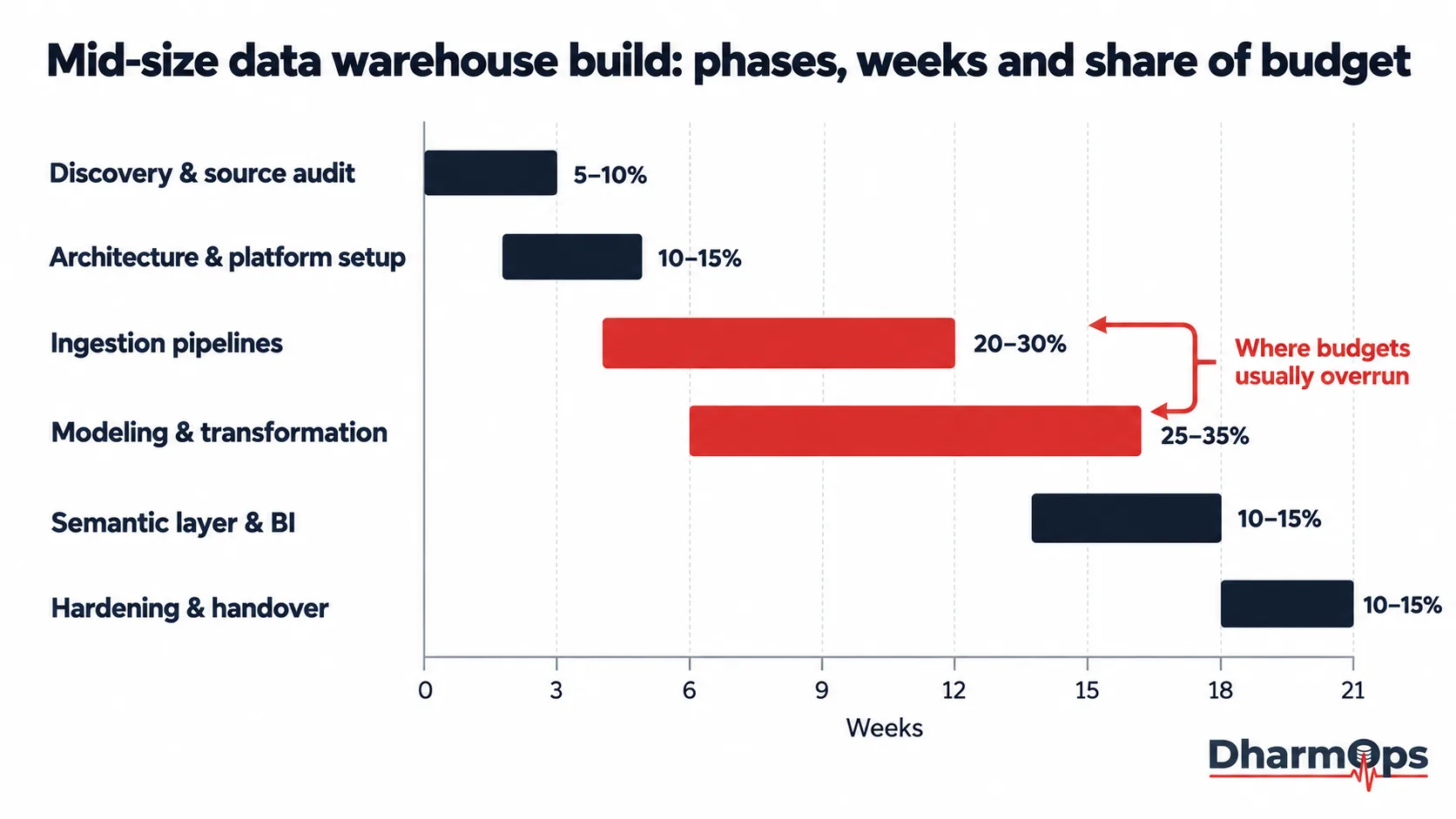
Where budgets usually overrun
Phases 3 and 4 overrun because of surprises in the source data: a field that's empty 20% of the time, or a metric with three versions. A discovery phase that tests real data finds these early.
How long it takes to build a data warehouse
A small warehouse takes 6 to 12 weeks. A mid-size build with an ERP and CRM takes 3 to 6 months. Enterprise builds take 6 to 12 months or more, usually delivered in stages.
What it costs to run: 2026 pricing by platform
There's no single cheapest warehouse. Each platform bills differently, so the cheapest one depends on how your team queries data.
| Platform | How it bills | 2026 list price (US) | Your bill grows with | Usually cheapest when |
|---|---|---|---|---|
| Snowflake | Credits for each second a warehouse runs (60-second minimum) | About $2 / $3 / $4 per credit for Standard / Enterprise / Business Critical (source) | Warehouse size × time running | Many users, mixed workloads, good auto-suspend habits |
| Google BigQuery | Per TiB scanned (on-demand), or slot-hours | $6.25 per TiB, first 1 TiB a month free (Google) | Data scanned per query | Spiky or modest query volume, partitioned tables |
| Amazon Redshift Serverless | RPU-hours | About $0.375 per RPU-hour | Compute time × base capacity | Teams committed to AWS, steady workloads |
| Databricks SQL Serverless | DBUs, compute included | About $0.70 per DBU (source) | DBUs used | Teams already running ML on Databricks |
| Microsoft Fabric | Capacity size (F-SKU), always on unless paused | F2 about $263/month; F64 about $8,410/month pay-as-you-go (source) | Capacity size | Microsoft and Power BI shops |
| PostgreSQL-based (e.g. Crunchy Data Warehouse) | Instance size | About $178 to $5,696/month (Crunchy Data) | Instance size | Under about 1 TB, small team |
Snowflake vs. BigQuery vs. Databricks: which is cheaper?
BigQuery on-demand is hard to beat for occasional queries on well-partitioned tables. Snowflake tends to win when many people query all day and warehouses suspend quickly. Databricks makes sense if you already run Spark or ML there.
Don't choose on list price. Match the model to your query pattern, then test it on a month of real queries. See Snowflake vs. Databricks pricing for more.
Microsoft Fabric pricing, in one paragraph
Fabric charges about $0.18 per capacity unit per hour, so F2 costs about $263 a month and F64 about $8,410. A one-year reservation cuts that by about 41%, and OneLake storage adds about $0.023 per GB a month (source). Capacity bills whether you use it or not, so pause it outside working hours.
When F64 beats a smaller capacity plus Power BI licenses
Below F64, every Power BI viewer needs a paid license. From F64, free-license viewers can see shared content. One analysis puts the break-even at about 179 viewers on reserved pricing.
The tools around the warehouse
| Tool | What it does | How it bills | Typical 2026 cost |
|---|---|---|---|
| Fivetran | Ingestion | Monthly active rows | Median contract about $44,800 a year (Vendr) |
| Airbyte Cloud | Ingestion | Credits | Standard $20/month; Plus from $189/month (source) |
| dbt Cloud | Transformation | Per developer seat | Starter about $100 per seat a month (source) |
| dbt Core | Transformation | Free (open source) | Your engineers' time |
| Power BI Pro | BI | Per user | About $14 per user a month |
| Looker Studio | BI | Free | Free for basic use |
See our dbt ELT pipeline guide and data observability tools for more on these layers.
The people cost: build in-house, hire a firm, or both
People are usually the biggest running cost. A US data engineer averages about $136,400 in base pay, and the BLS puts the median database architect at $139,500.
Wages are only about 70% of what employers spend on compensation (BLS, June 2026). So one engineer costs about $195,000 a year with benefits.
| Option | Year-one cost (mid-size) | Time to first reliable dashboard | Main risk | Knowledge stays with you? |
|---|---|---|---|---|
| Hire 2 data engineers | About $390K, plus 2 to 4 months to hire | 6 to 9 months | Key-person risk | Yes |
| Hire a firm for a fixed project | Build fee + optional support retainer | 3 to 6 months | Scope risk (carried by the firm) | Only with a proper handover |
| Firm builds, 1 hire runs it | Build fee + about $195K | 3 to 6 months | Lowest | Yes, if they overlap from day one |
When a full-time hire makes more sense
Hire first if data is core to your product, you'll add sources every month, or you already have a data lead. Use a firm when you need a first version within a quarter, or nobody in-house has built a warehouse before.
What to ask a firm before you sign
Ask for estimated hours, not just a rate. Ask what's excluded, what happens after go-live, and who owns the code. Our guide to how database consulting quotes differ covers this in detail.
Related: data warehouse implementation
Not Sure Which Option Fits Your Team?
Start with a 30-minute discovery call. We'll look at your sources and tell you whether hiring, a firm or both costs less.
Book a Discovery CallWarehouse, lake or lakehouse: which costs less?
Pick the architecture from your workload, not from what's popular.
| Your main workload | Cheaper fit | Why |
|---|---|---|
| Dashboards and reports on structured business data | Data warehouse | Simple to model, fast for BI, predictable cost |
| Large raw, semi-structured or event data, plus ML | Lakehouse | Cheap object storage, one copy for BI and ML |
| Under about 1 TB, a few sources, one analyst | PostgreSQL | No new platform to learn or pay for |
How open table formats change storage cost
Apache Iceberg and Delta Lake keep data as standard files in object storage like Amazon S3, at object-storage prices. Several engines can read the same files, so you don't store or move data twice. See Iceberg vs. Delta Lake for the trade-offs.
Three real budgets, itemized
These example budgets use 2026 list prices and typical engineering rates. Build hours are priced at about $175 to $185 an hour, and one full-time engineer at about $195K a year with benefits.
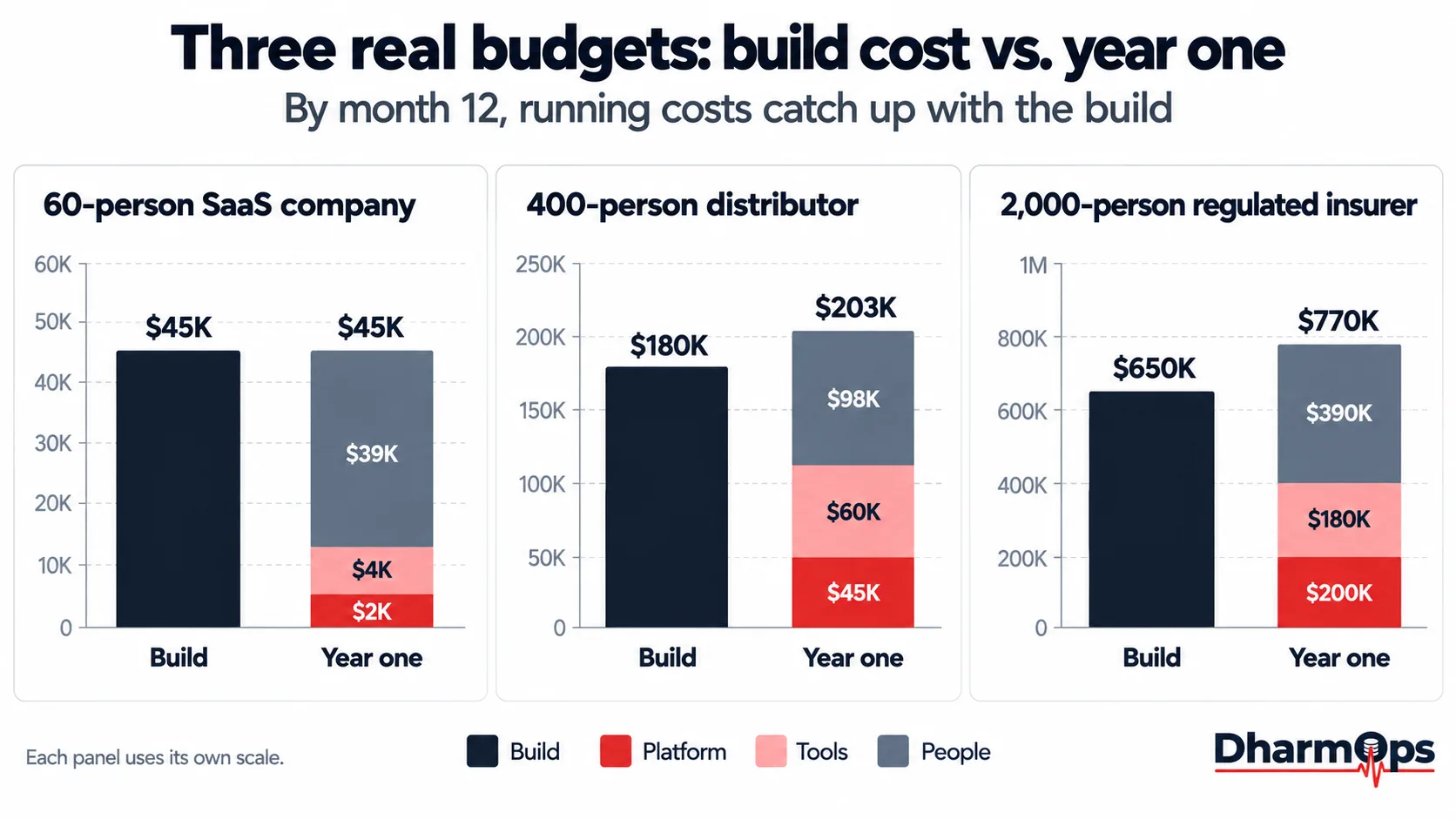
Example 1: A 60-person SaaS company building its first warehouse
Six sources (product PostgreSQL, Stripe, HubSpot, Zendesk, Google Analytics, ad platforms), refreshed daily. Stack: BigQuery, Airbyte Cloud, dbt Core, Looker Studio.
| Line item | Cost |
|---|---|
| Build: about 260 hours | $45K |
| Platform: BigQuery on-demand, a few TB scanned a month | $2K |
| Tools: Airbyte Plus and extra credits; dbt Core and Looker Studio are free | $4K |
| People: about one day a week of an engineer (0.2 FTE) | $39K |
| Year one total | $45K |
What drove the cost: not the software, which stays under $6K a year. Almost all of it is the engineer who keeps pipelines healthy.
Example 2: A 400-person distributor joining its ERP and CRM
Fifteen sources, including NetSuite (or Dynamics 365) and Salesforce, refreshed hourly. Finance stops reconciling orders in spreadsheets. See a similar setup in our logistics data case study. Stack: Snowflake Enterprise, Fivetran, dbt Cloud, Power BI.
| Line item | Cost |
|---|---|
| Build: about 1,000 hours, most of it on the ERP | $180K |
| Platform: Snowflake, about 15,000 credits at about $3 | $45K |
| Tools: Fivetran (about $40K), dbt Cloud 3 seats ($3.6K), Power BI Pro for 100 users ($16.8K) | $60K |
| People: half of one engineer (0.5 FTE) | $98K |
| Year one total | $203K |
What drove the cost: the ERP. It took the most build hours, and its hourly sync drives most of the Fivetran bill. Daily data would cut both.
Example 3: A 2,000-person regulated insurer moving off on-premises Oracle
Thirty-plus sources, led by an on-premises Oracle database pulled through CDC. Three feeds need near-real-time data, under HIPAA and SOC 2 controls. Our insurance Oracle-to-PostgreSQL case study shows this kind of migration. Stack: Databricks SQL (Fabric is a common alternative), CDC ingestion, Power BI, catalog and monitoring.
| Line item | Cost |
|---|---|
| Build: about 3,500 hours, delivered in stages | $650K |
| Platform: Databricks, near the median buyer contract (Vendr) | $200K |
| Tools: Oracle CDC (about $90K), Power BI Pro for about 400 users (about $67K), catalog and monitoring (about $23K) | $180K |
| People: two full-time engineers | $390K |
| Year one total | $770K |
What drove the cost: compliance and the legacy Oracle source. Access controls and audit work added build time, and real-time feeds plus two engineers drive the running cost. See our data platform modernization service.
How to estimate your own data warehouse cost in 6 steps
You can reach a defensible first number in an afternoon. Write each answer down.
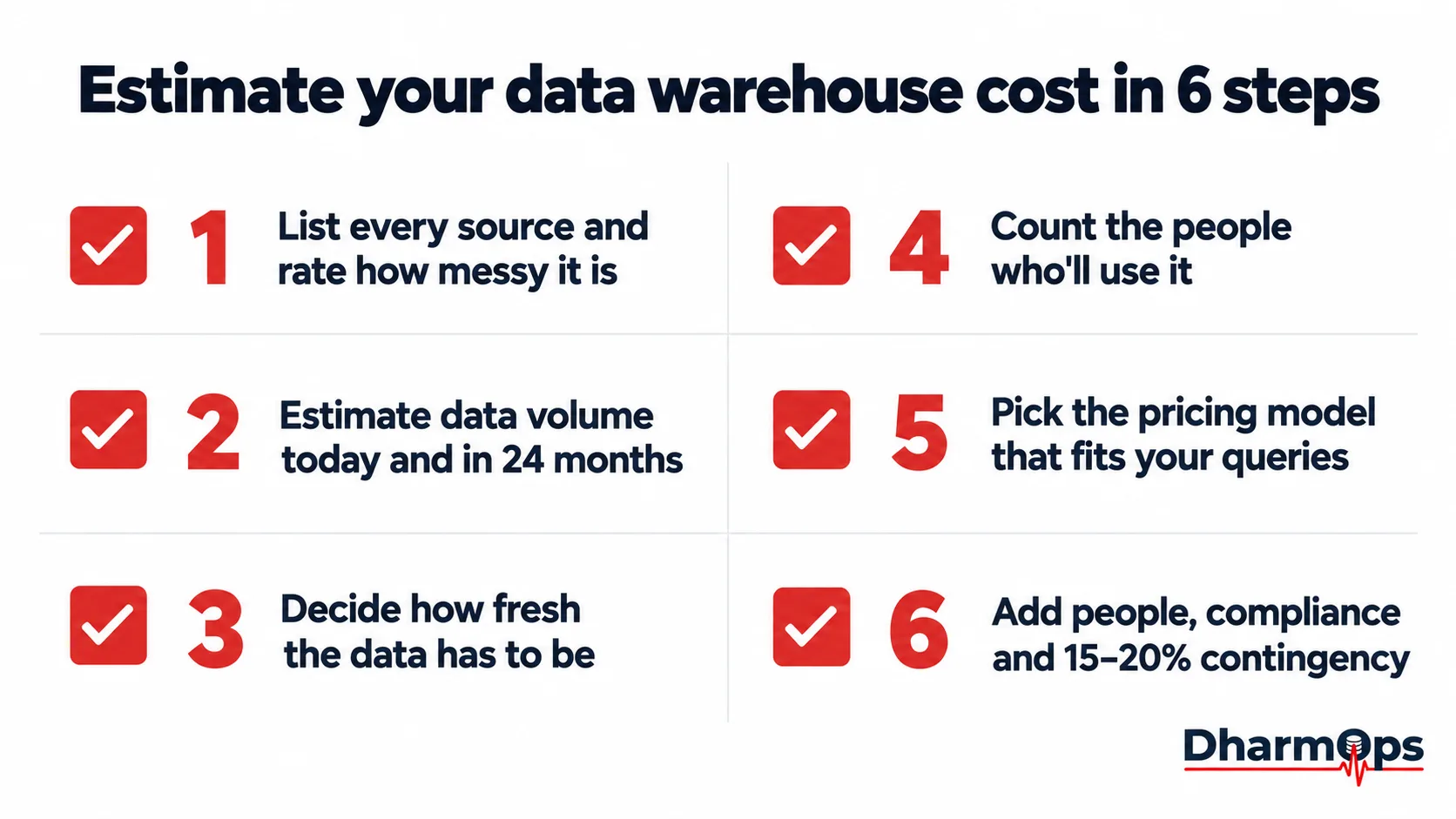
Step 1: List every source and rate how messy it is
Mark each system as a clean SaaS app, a custom database or an ERP. The last two take most of the build budget.
Step 2: Estimate data volume today and in 24 months
A company with 200 GB growing 5% a month will have about 650 GB in two years. Budget for that.
Step 3: Decide how fresh the data has to be
If finance reviews numbers each morning, daily loads are enough. Pay for hourly or real-time data only where someone decides within the hour.
Step 4: Count the people who'll use it
Split them into engineers, analysts and viewers. Viewers drive BI license costs. Analysts drive query costs.
Step 5: Pick the pricing model that fits your queries
Occasional queries suit pay-per-scan pricing like BigQuery on-demand. All-day querying by many people suits credits or capacity, like Snowflake or Fabric.
Step 6: Add people, compliance and a 15 to 20% contingency
Add about $195K a year per full-time engineer, extra time for compliance, and 15 to 20% for source-data surprises.
Want to Check Your Number?
Start with a 30-minute discovery call. We'll review your estimate with you.
Book a Discovery CallMistakes that blow up a data warehouse budget
Most overruns come from a short list of avoidable decisions.
Leaving warehouses running when nobody's using them
Snowflake bills for every second a warehouse is on, and Fabric capacity bills around the clock. Set auto-suspend to a minute or two, and pause capacity after hours.
Sizing compute for peak load on day one
Start small and scale up when real queries need it. Sizing up is easy. Explaining an oversized bill isn't.
Buying a commitment before 90 days of real usage
Run pay-as-you-go for about three months, then commit based on what you actually use.
Syncing high-churn tables through row-based ingestion
Tables that update or delete constantly inflate ingestion bills, especially now that Fivetran counts deletes. Sync them less often or move them another way.
Building dashboards before agreeing on metric definitions
If finance and sales define "revenue" differently, the dashboards will disagree and get rebuilt. Agree on metrics in discovery. Our data analytics service starts there: written definitions for your key numbers, then one dashboard per role.
Having no cost owner and no spending limits
Name one owner for the bill. Set up Snowflake resource monitors, BigQuery quotas or budget alerts on day one.
Treating data cleanup as someone else's job
Bad data doesn't fix itself in the warehouse. Give each source system an owner who fixes problems at the source.
How to keep year-two costs under control
Review cost monthly: fix the most expensive queries, partition large tables, move old data to cheaper storage, and retire dashboards nobody opens. Our database FinOps guide covers the process, and our data infrastructure FinOps service runs it for you.
Do you even need a data warehouse?
Not every company needs one yet. If your reports already agree and you have only a few sources, a simpler setup costs far less.
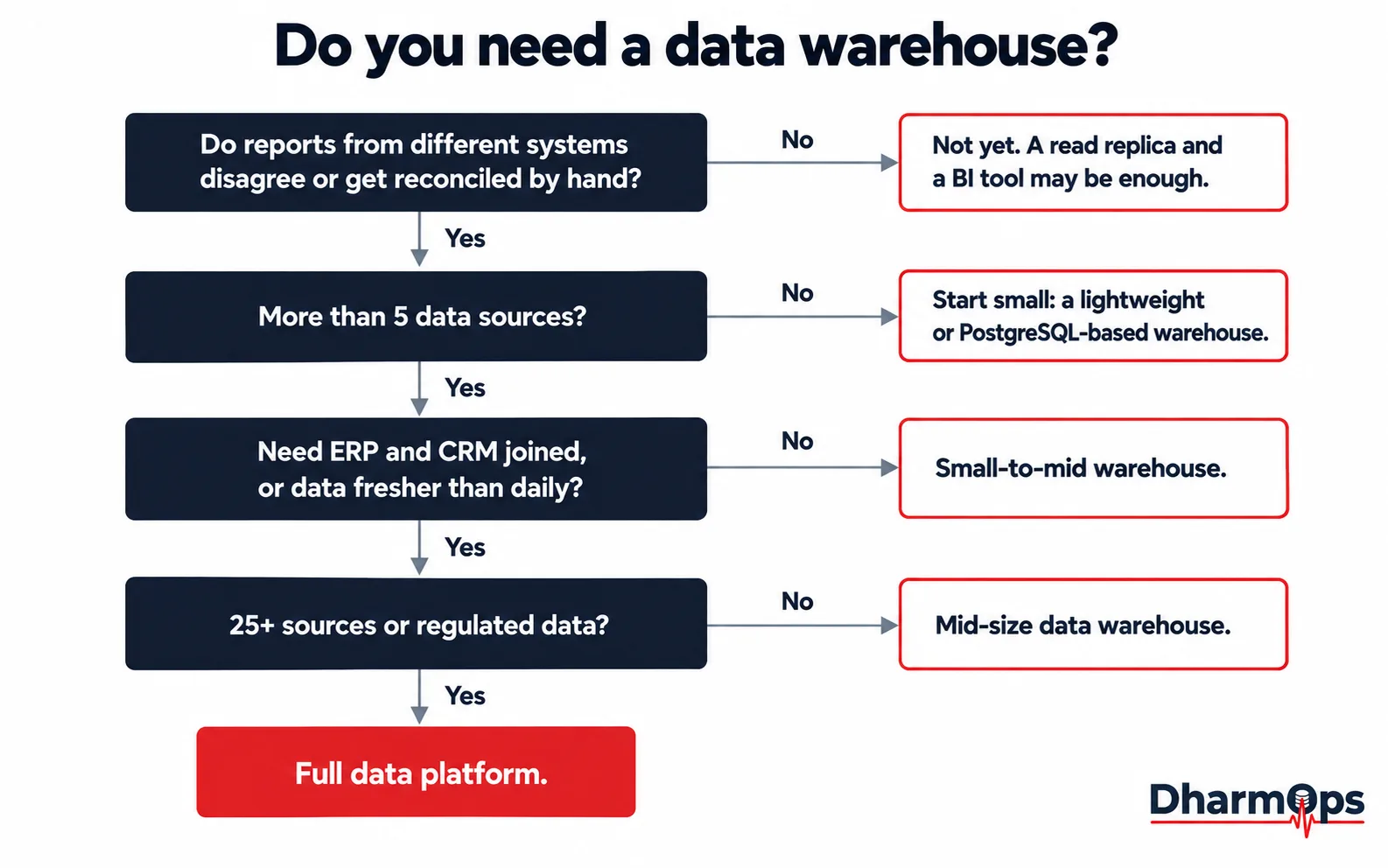
You can probably wait if you have fewer than five sources, under 50 GB of data and one analyst. A read replica plus a BI tool will carry you.
You likely need one if reports from different systems disagree, finance reconciles numbers by hand, or you need your ERP and CRM joined to answer basic questions.
Do you need a data warehouse for Power BI?
Not always. Power BI connects directly to a few sources. With many sources, large volumes or shared logic, a warehouse keeps reports consistent and fast.
What to do before you ask for a quote
Prepare four things and you'll get tighter quotes you can compare like for like:
- Every source system, noting which are ERPs or custom databases.
- Rough data volumes for the largest sources, and their growth.
- How fresh each dataset needs to be: daily, hourly or near-real-time.
- Who will use it: engineers, analysts and report viewers.
How we help with this
DharmOps works out what your warehouse should cost before anything gets built. It starts with a 30-minute discovery call to understand what you need. Then a scoped diagnostic of your sources, data and team tells us which platform fits, whichever vendor that is.
From there, we handle the data warehouse implementation or the data warehouse modernization as a fixed plan, and stay on for support so running costs don't drift.
Holding a quote, or setting a budget? We'll tell you what your warehouse should cost to build and to run.
Book a Discovery CallFrequently Asked Questions
How much does a data warehouse cost per month?
From a few hundred dollars a month for a small team on BigQuery to $20K+ for a large enterprise, before staff. One full-time data engineer adds about $16K a month with benefits.
What is the average cost of a data warehouse implementation?
About $25K to $80K for a small team, $80K to $300K for a mid-size company and $300K to $1M+ for an enterprise. Sources, freshness and compliance decide where you land.
How long does it take to build a data warehouse?
Six to 12 weeks for a small warehouse, 3 to 6 months for a mid-size build with an ERP and CRM, and 6 to 12 months or more for an enterprise.
Is Snowflake cheaper than Databricks?
Not for every workload. Snowflake usually costs less for SQL dashboards with many users. Databricks usually costs less if you already run data engineering or ML on it. Test both on real queries.
How much does Microsoft Fabric cost?
Pay-as-you-go runs about $263 a month for F2 and about $8,410 for F64. A one-year reservation cuts that by about 41%, and storage adds about $0.023 per GB a month.
Do you need a data warehouse for Power BI?
Not always. Power BI connects directly to a few sources. With many sources or shared logic, a warehouse keeps reports consistent.
Should we hire a consulting firm or build the warehouse in-house?
A firm usually delivers a first version in 3 to 6 months. Hiring builds long-term ownership but takes months to recruit. Many teams have a firm build it and one in-house engineer take it over.
How do you calculate data warehouse cost?
Add the one-off build cost, the yearly platform and tool costs, and the yearly cost of the people who run it. Then add 15 to 20% contingency.
How we got these numbers: the example budgets are modeled on 2026 list prices and typical engineering rates, not client invoices. Prices come from vendor pricing pages and buyer data linked throughout. Check current prices with each vendor before you commit.
Get a Straight Answer on Your Setup
Tell us what you're running into. We read every message personally and reply within 24 hours with times for a 30-minute discovery call.