Moving to RDS, Aurora or Snowflake came with a lovely promise: the cloud runs the database now. And it does. It runs it straight into a bigger bill.
Most teams believed it and handed the database to feature developers. The provider handles hardware, patching and backups. It doesn't touch slow queries, schemas or instance sizes.
Flexera's 2026 State of the Cloud report puts wasted cloud spend at 29%, the first rise in five years.
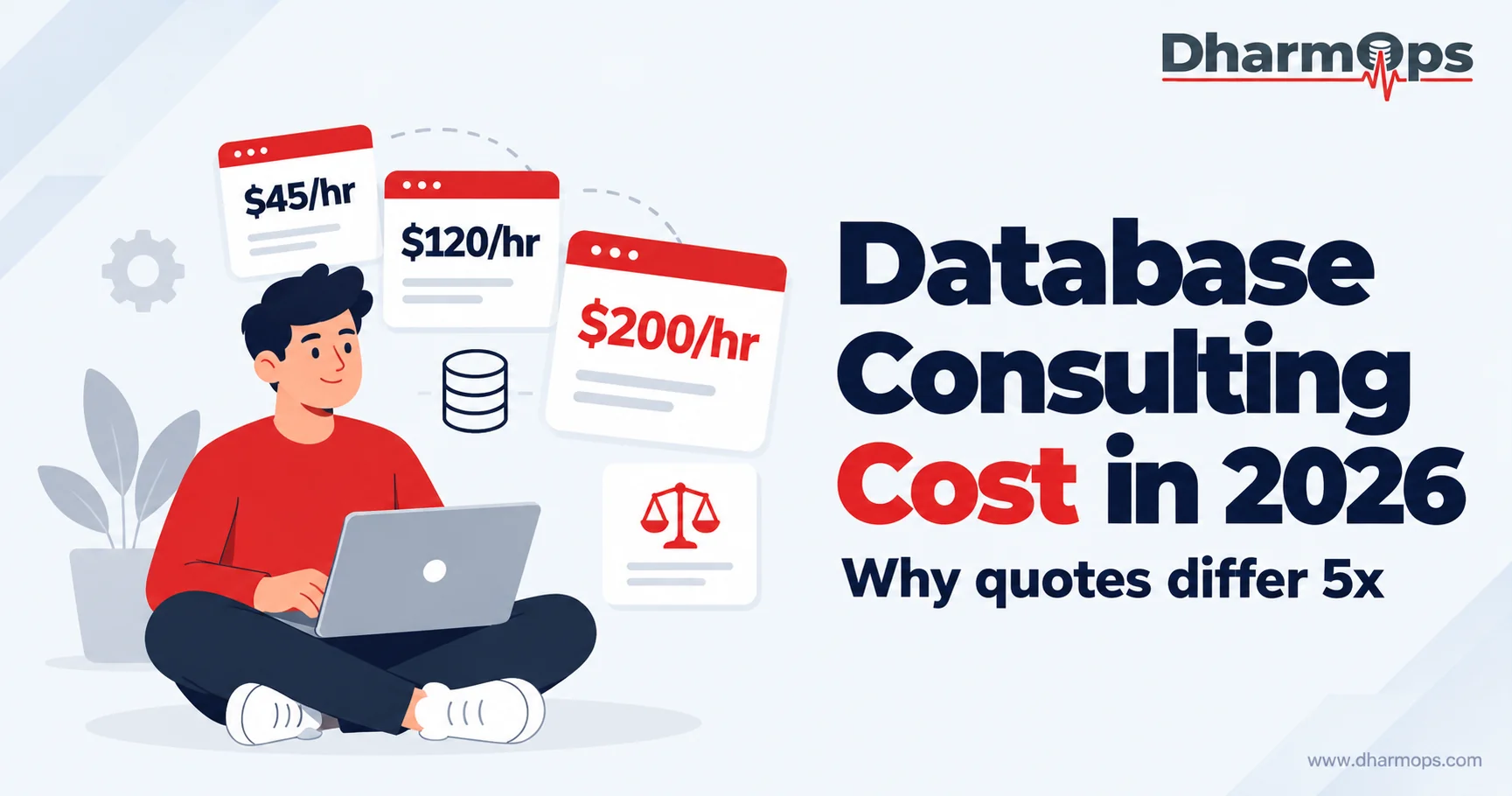
Then you ask for help, and the quotes don't line up. One wants $45 an hour, another $200, for the same job. Most guides on database consulting cost mix salaries with fees, print a range and stop. None of them explain why one problem gets quotes 5x apart.
There is a pattern behind the spread. GSA's federal pricing data holds 3,229 contract rates for database administrators. The median is $129 an hour, and 80% fall between $87 and $187. Eight factors decide where your quote lands on that line, and most of them sit on your side of the table.
This guide covers what the market charges in 2026, the eight factors that move a quote, and how each pricing model shifts risk between you and the consultant. Further down, one slow Aurora database gets three quotes between $2,700 and $4,800, and the cheapest one buys the least. You'll finish with a six-step check to run on any quote before you sign.
Jump to: Rates · The 8 factors · Check your quote
Already holding quotes that don't match? Book a 30-minute discovery call →
How much does database consulting cost in 2026?
Most US database consulting costs between about $90 and $190 an hour in 2026. Offshore freelancers start near $35. Senior specialists charge $150 to $250 or more.
The spread comes from who you hire. Here is where each type of provider sits.
| Who you hire | Typical hourly rate | Source |
|---|---|---|
| Marketplace freelancer | $35 to $75 (median about $50) | Fiverr, 2026 |
| Offshore developer (Asia) | $37 to $86 | SecondTalent, 2026 |
| US database developer or DBA | $92 to $145 | SecondTalent, 2026 |
| US contractor through a staffing firm | $98 to $140 | Kore1 Contract Rate Index, Oct 2026 |
| Federal contract ceiling, database administrator | $87 (low) / $129 (median) / $187 (high) | GSA CALC, 3,229 rates |
| Senior specialist or boutique firm | $150 to $250+ | Tambena; Darling Data |
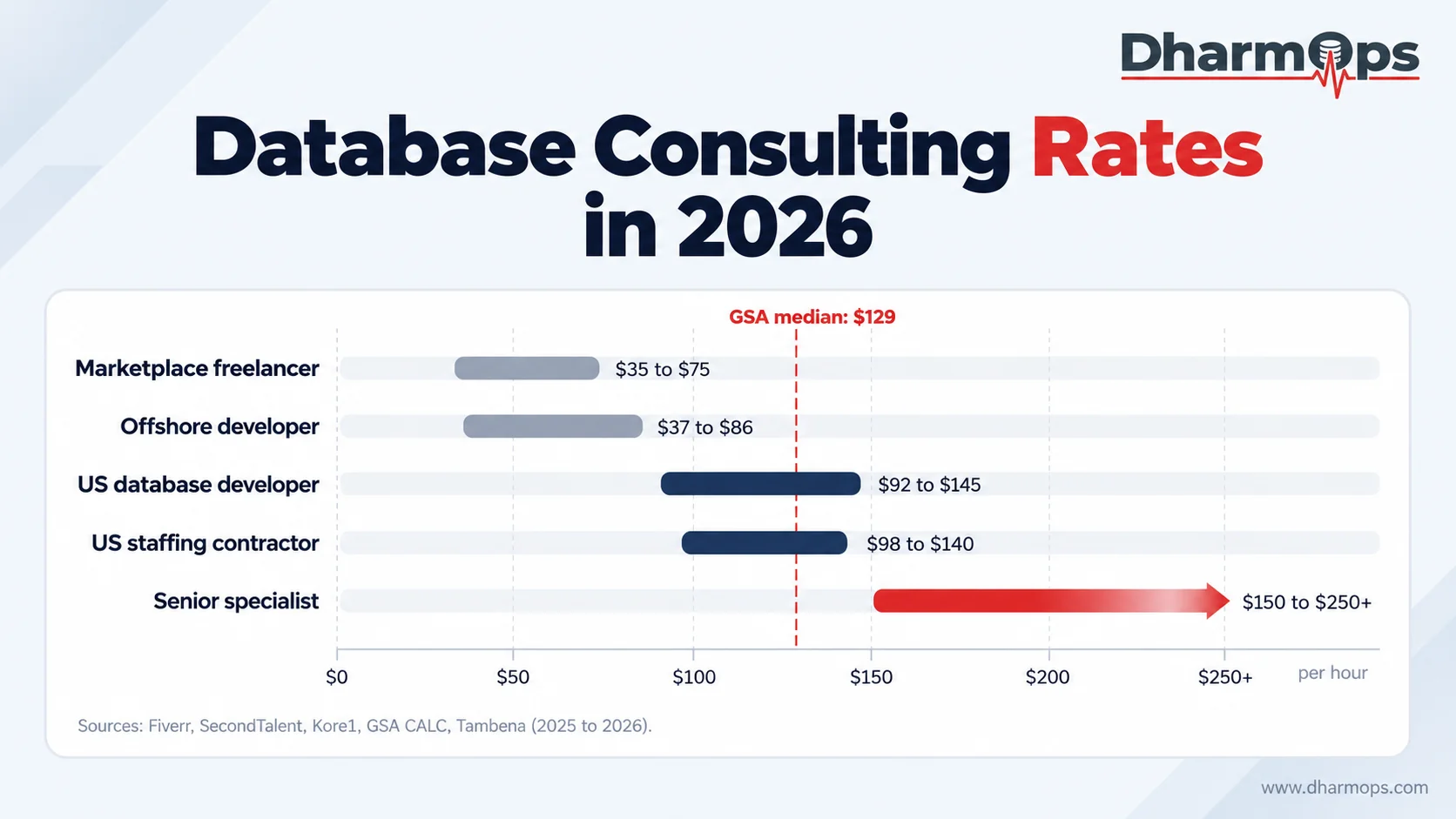
Sources: Fiverr, SecondTalent, Kore1, GSA CALC, Tambena and Darling Data.
Read the GSA numbers as a reference point, not a price list. They are the most a contractor may bill the federal government for that role.
What you're paying for
A database consultant finds out why your database is slow, expensive or fragile, then fixes it. The work covers queries, indexes, schema design, configuration, instance sizing, backups and migrations.
The useful ones also leave a record of what they changed and why. Without that, your team inherits a faster database it can't explain.
What waiting, or choosing on rate alone, costs
Signs it's time to bring someone in
You don't need a consultant because your database exists. You need one when the database starts showing up in business conversations. These are the usual signs:
- Query latency or timeouts grow faster than your traffic.
- The database bill rises every quarter with no new product load.
- A migration or major version upgrade sits on the roadmap.
- Feature developers spend sprint time on database incidents.
- An audit or compliance deadline touches the data layer.
If two or more of these sound familiar, the question isn't whether to get help. It's how much to pay for it.
Scaling up is the default when nobody owns the database
When nobody on the team knows the database internals, every slowdown gets the same fix: a bigger instance. An engineer in a recent r/aws discussion put it plainly. Without that knowledge, teams "default to scaling up" instead of fixing queries and schemas.
The bigger instance buys a quarter. Then the data grows, the same queries slow down, and the next upgrade lands on the bill.
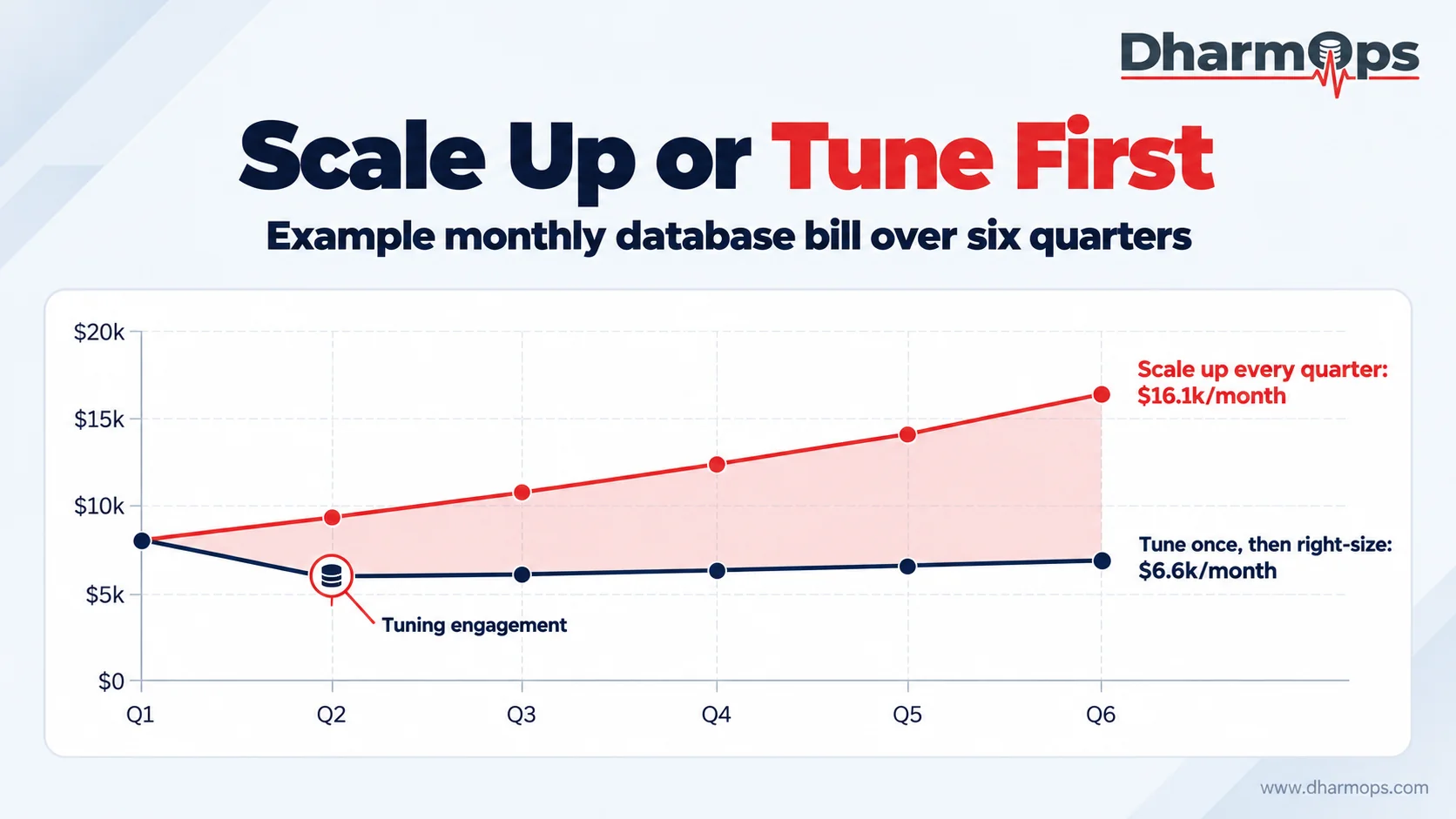
Take the example in the chart. A team at $8,000 a month that scales up each quarter reaches $16,100 a month by quarter six. A team that tunes once and right-sizes drops to $6,000 and ends at $6,600. Over those 18 months, the gap is about $93,000.
If your bill looks like the red line, start with why AWS RDS bills climb and the AWS RDS cost optimization playbook.
Developer time is part of the bill
Every hour a product engineer spends on a database incident is an hour off the roadmap. That cost never appears on the cloud invoice. It appears in what doesn't ship.
What's different about database consulting in 2026
Managed cloud moved the work, it didn't remove it
RDS, Aurora and Snowflake take care of hardware, patching and backups. They don't design your schema, rewrite your queries or pick your instance size. That work used to belong to a database administrator. On many teams today, it belongs to nobody.
AI-assisted tuning changes what you pay for
AI tools now handle a lot of routine diagnosis. Redgate's 2026 State of the Database Landscape found AI use in database management nearly tripled in a year, from 15% to 44% of organisations.
That shifts what a consultant's hours are worth. Reading logs gets faster. Deciding how to redesign a schema, or whether to migrate at all, still takes judgement. In 2026, pay for decisions, not for time spent reading output.
New pricing levers on the cloud bill
AWS Database Savings Plans cut database costs by up to 35% in exchange for a one-year usage commitment. The discount follows you across engines, instance families and regions.
There's a catch. A commitment locks in whatever size you're running. Commit before you right-size, and you've signed up to pay for the waste at a discount for a year.
More teams are looking for help
Google Trends shows US search interest in "database consultant" rising about tenfold between 2024 and 2026. Over the same period, interest in "database administrator" stayed flat. More teams are buying database expertise by the project instead of by the hire.
So what decides whether your quote lands at $40 or $250 an hour? Eight things.
What changes the range: 8 factors behind every quote
The GSA median sits at $129 an hour. These eight factors push a quote above or below it.
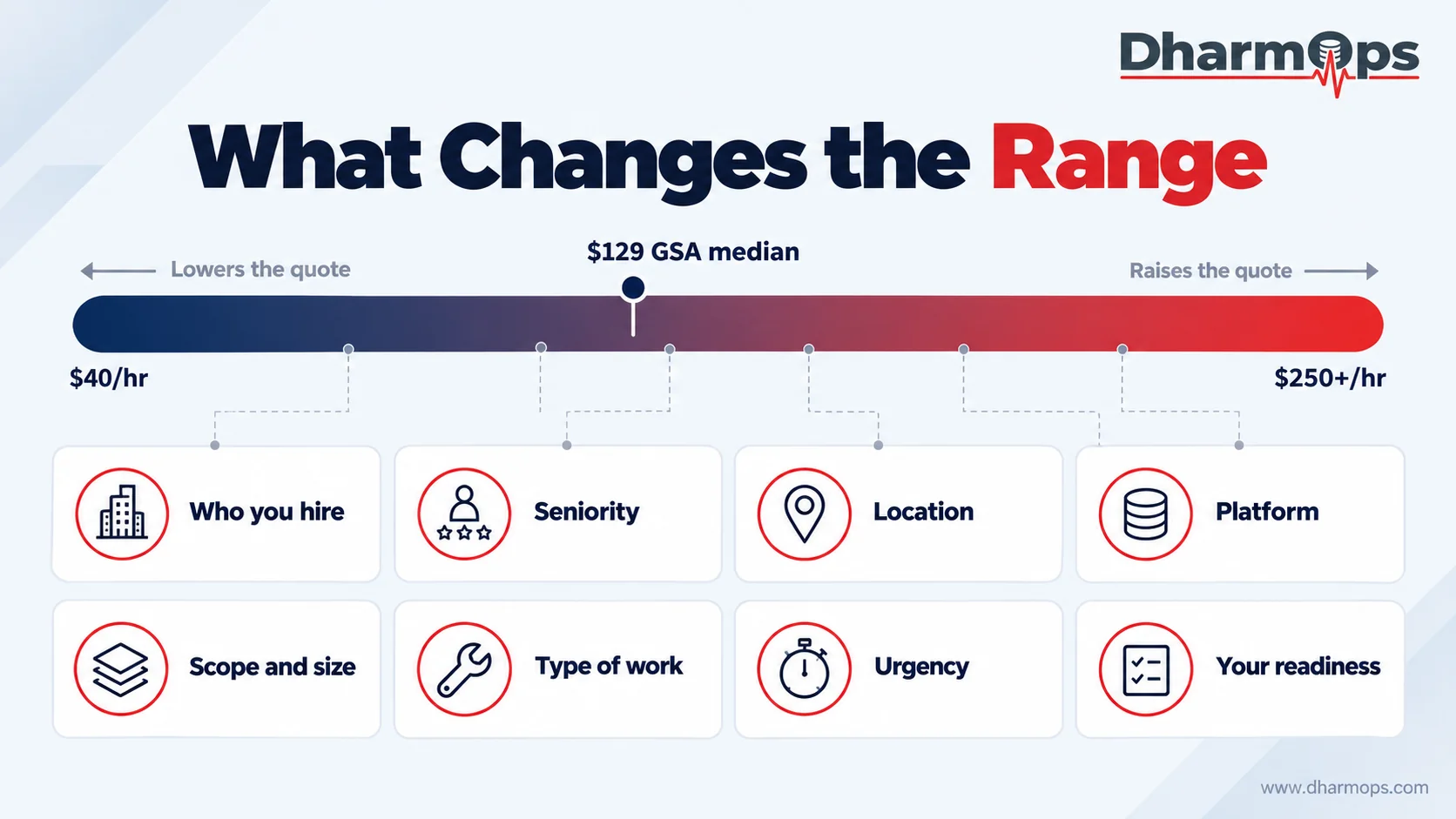
1. Who you hire
A freelancer's rate covers their hours and little else. A staffing firm adds its margin on top of the contractor's pay. A specialist firm prices in the team behind the person you talk to. A large integrator adds account managers and project layers.
Same job title, four different overheads.
2. Seniority
A senior consultant costs more per hour and often less per problem.
Say an index problem takes a senior consultant 2 hours at $200, and a junior one 12 hours at $60. The senior bill is $400. The junior bill is $720, and that assumes the junior finds the right fix.
3. Where the consultant is based
Location moves rates a lot. Clutch's October 2026 pricing guide puts US analytics firms at $100 to $149 an hour and Indian firms at $25 to $49.
Time zones matter too. If your incidents happen during your business hours, an offshore team may be asleep for them. Overlap and on-call coverage are part of what you're buying.
4. The database platform
PostgreSQL and MySQL have large talent pools. Oracle and SQL Server work often involves licensing and edition questions as well as tuning. Fewer people do that well, and it usually shows in the rate.
Managed cloud adds its own skills. Tuning Aurora or Snowflake isn't the same job as tuning a server you control.
5. Scope and environment size
Instance count, data volume, high availability, disaster recovery and compliance all add hours.
Instance count alone is a weak guide, though. Straight Path Solutions explains why it prices by hours, not per instance. One of its clients needs its largest plan for one or two very large SQL Server instances. Others run dozens of simple instances on far fewer hours.
Why a migration costs more than a tune-up
A migration isn't one task. It's schema conversion, code conversion, testing, cutover and a rollback plan, and each one is billable. Our guide to database migration cost in 2026 breaks down where that budget goes.
6. Type of work
From narrowest to broadest, the usual work types are a health check, performance tuning, schema redesign, migration and ongoing administration. Each step up adds discovery, testing and risk. A health check might take days. A migration can take months.
7. Urgency and coverage
A planned tuning project and a 2am outage are priced differently. Emergency work, 24/7 on-call and committed response times all raise the rate. You're paying for someone to be available, not only for the hours they work.
8. Your readiness
This is the factor you control most. A consultant with no monitoring, no documentation and no staging copy spends paid hours just finding their way around.
Before you ask for a quote, get these ready:
- Read access to the database and its metrics
- The slow-query log, or pg_stat_statements on PostgreSQL
- A rough diagram of what talks to the database
- A copy of production data the consultant can test against
Each item you prepare cuts discovery hours from the quote.
How database consultants charge: hourly, project or retainer
Every pricing model puts the risk of a wrong estimate on someone. Knowing who carries it tells you which model fits your situation.
| Model | Best when | Risk sits with | Watch for |
|---|---|---|---|
| Hourly (time and materials) | Scope is unclear, short fixes | You | No cap on hours; ask for an estimate range |
| Fixed project fee | Scope is clear (audit, defined migration) | Consultant | Change requests priced separately |
| Monthly retainer or pool of hours | Support after the fix | Shared | What's included vs what uses hours |
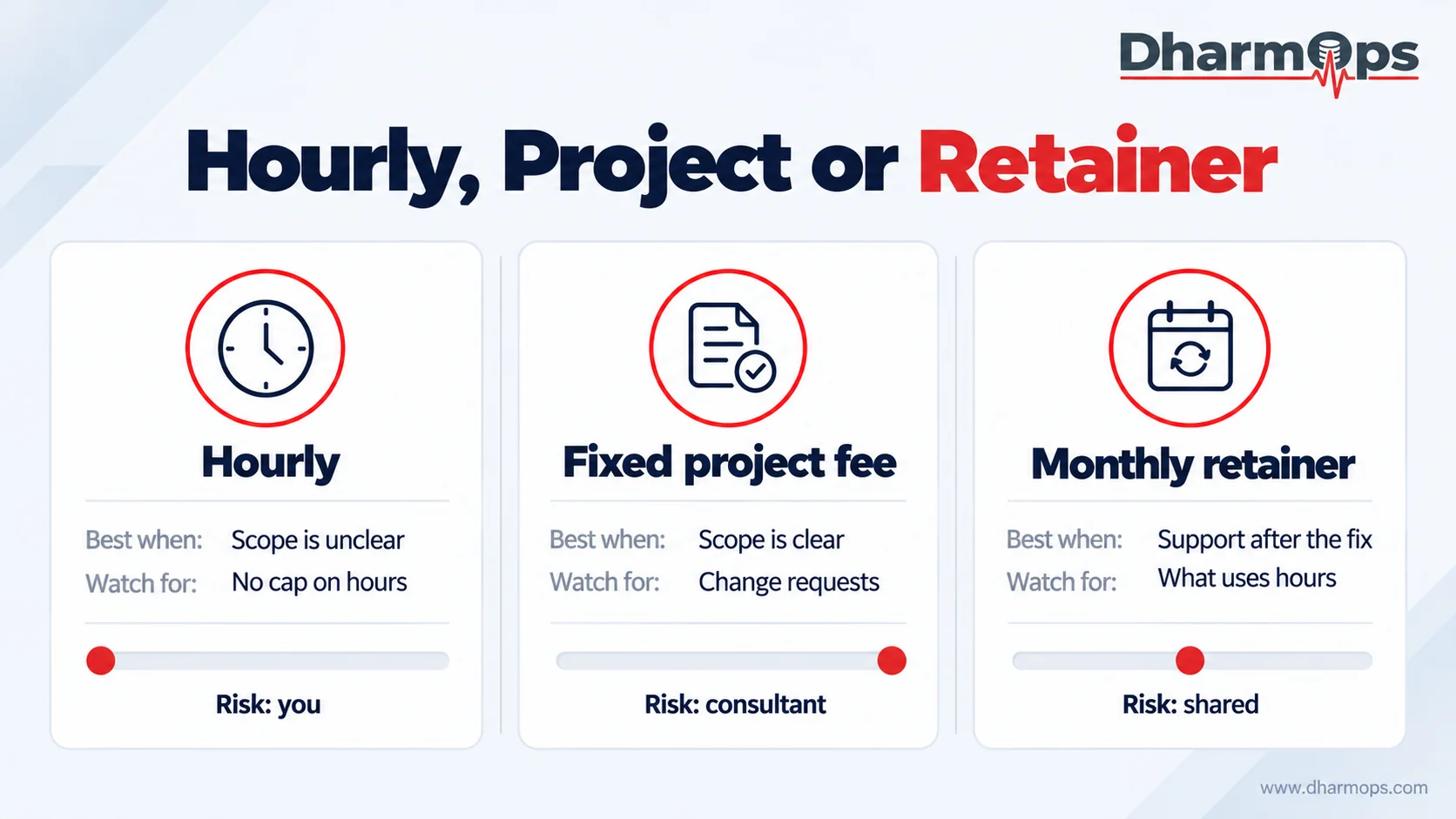
Hourly
Hourly works when nobody knows yet what's wrong. You pay for exactly the time used. You also pay for every wrong turn, so ask for an estimate range and what pushes it to the top.
Fixed project fee
A fixed fee works when the scope is clear: an audit, a defined migration, a set list of queries. The consultant carries the risk of overrunning, so expect a buffer in the price. Anything outside the scope becomes a change request.
Monthly retainer
A retainer works for ongoing support. You buy a block of hours or coverage each month. Darling Data, for example, lists a SQL Server performance retainer at $2,500 a month. Check what comes with the plan, like monitoring and alert triage, and what uses up your hours.
Why a diagnostic first often lowers the total
A big quote on an unclear problem carries a risk buffer. The consultant doesn't know what they'll find, so they price for the worst case.
A short diagnostic removes most of that uncertainty. Once the cause is known, the fix can be scoped and priced as a fixed project. You stop paying for the unknown.
This is how DharmOps works. A discovery call to understand the problem, then a scoped diagnostic, then a fixed plan for the fix.
What happens after the fix
Some consultants fix the problem and leave. That works until the data grows, a new feature ships a slow query, and the same problem returns with nobody watching.
DharmOps fixes the problem, then stays on for ongoing support, so it doesn't come back after handover.
Related: database engineering services
Not Sure Which Quote to Trust?
Start with a 30-minute discovery call. Bring the quotes you have, and we'll show you what each one covers and what it leaves out.
Book a Discovery CallCosts that sit outside the consultant's invoice
Tooling and migration services
Migration tools have their own bills. AWS Database Migration Service and Google's Database Migration Service charge for the resources they run on. Those charges come from your cloud provider, not the consultant.
Licensing
Commercial databases carry licence costs that no tuning removes. On RDS for SQL Server, AWS notes that Savings Plans only discount the instance. The SQL Server licence is billed separately.
Your team's time
Your engineers will join calls, answer questions and test changes. Budget a few hours a week from at least one person for the length of the engagement.
Knowledge transfer
If nobody on your side can run what was built, you'll pay for it again later. Ask for documentation and a handover session as named deliverables.
Here's how those pieces add up on one problem.
Same job, three quotes: a worked example
A Series B SaaS company runs PostgreSQL on Aurora. Over six months, p95 API latency has tripled and the database bill is up 40%. They ask three providers for a quote.
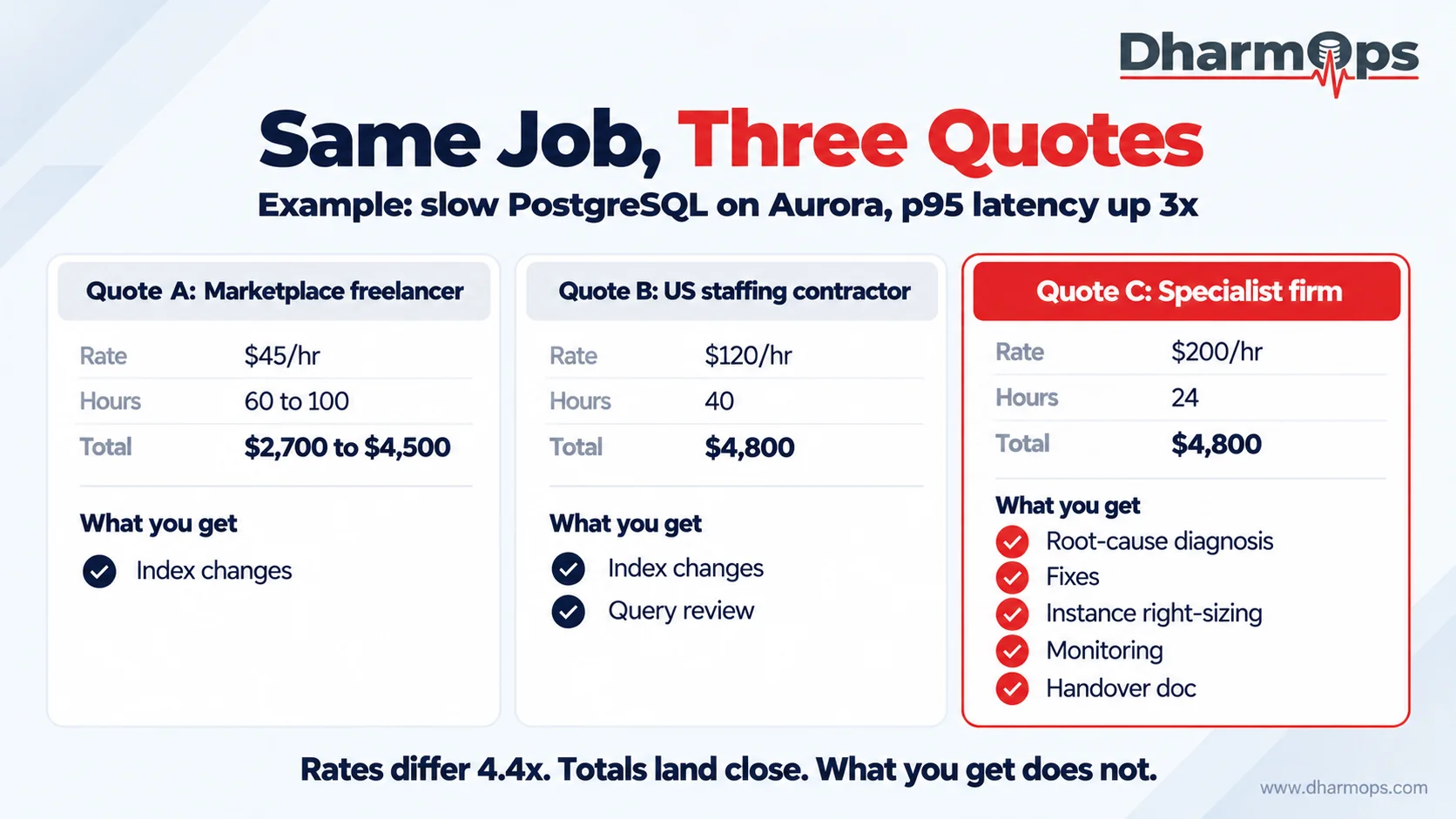
| Quote A: Marketplace freelancer | Quote B: US staffing contractor | Quote C: Specialist firm | |
|---|---|---|---|
| Rate | $45/hr | $120/hr | $200/hr |
| Hours | 60 to 100 | 40 | 24 |
| Total | $2,700 to $4,500 | $4,800 | $4,800 |
| What you get | Index changes | Index changes, query review | Root-cause diagnosis, fixes, instance right-sizing, monitoring, handover doc |
Quote A looks cheapest and has the widest range. Adding indexes may help latency. It won't touch the 40% bill increase, and nobody checks whether the problem comes back.
Quote B adds a query review. That's closer to the cause, but the cost side is still untouched.
Quote C costs the same as B and covers both problems. Right-sizing the instance after the fix goes after the bill. Monitoring and a handover doc mean the team knows if latency creeps up again.
The rates differ 4.4x. The totals land within $2,100 of each other. What you get differs most of all.
Quote C's scope is the kind of work that fixed a 340GB PostgreSQL database DharmOps took on. Reports that took 4 minutes now run in 17 seconds. The team reclaimed 48GB of bloat and cut peak disk I/O by 60%, with no downtime and no application code changes. If your quotes only cover index changes, that's the gap to ask about. Read the PostgreSQL performance case study.
Holding quotes like these? Bring them to a discovery call and we'll go through them line by line.
How to check a database consulting quote in 6 steps
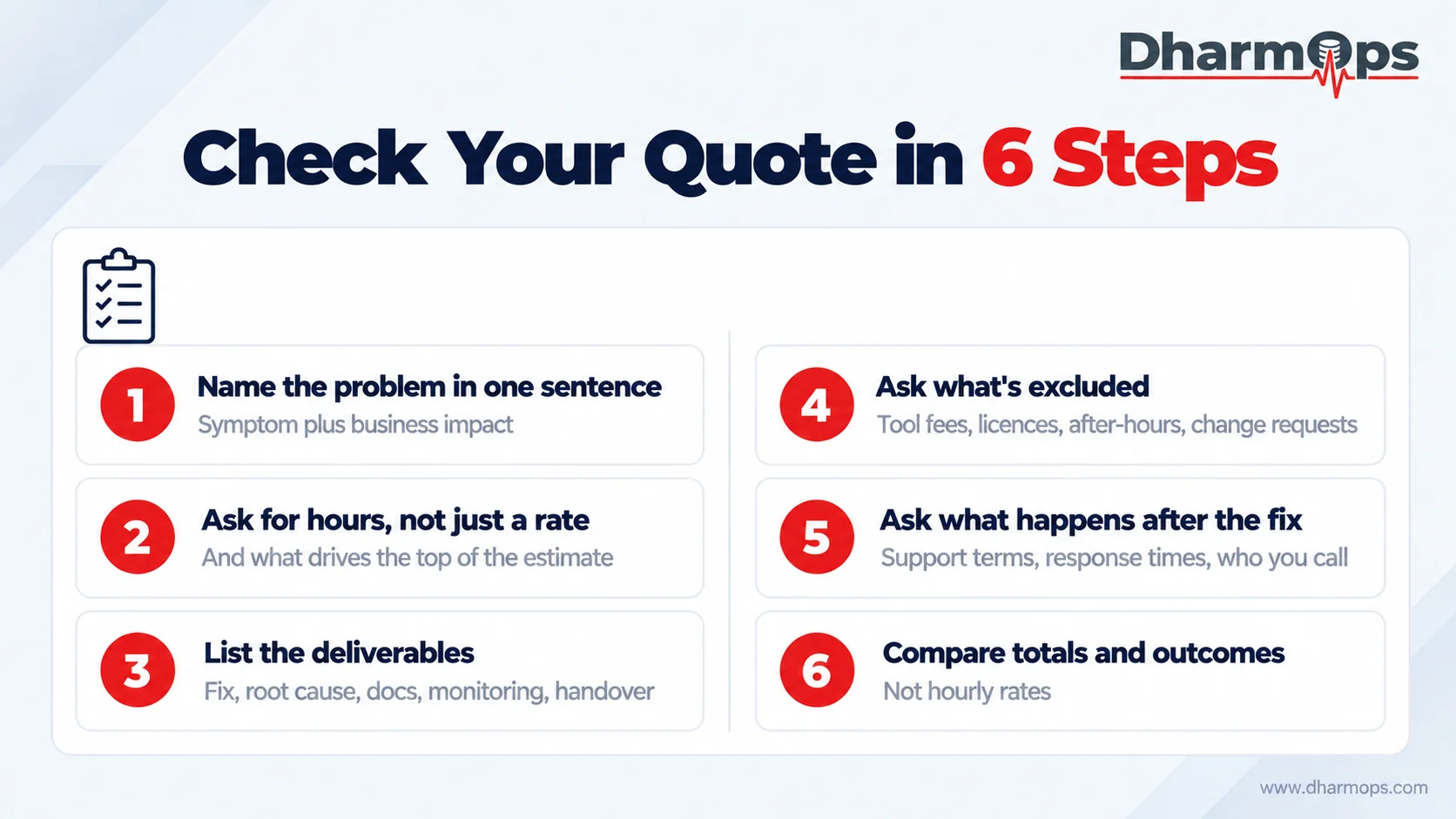
- Name the problem in one sentence. Include the symptom and what it costs the business. "Checkout API p95 went from 300ms to 900ms, and conversion dropped" beats "the database is slow."
- Ask for hours, not just a rate. A rate on its own tells you nothing about the total. Ask for an hours estimate and what would push it to the top of the range.
- List the deliverables. A fix, the root cause, documentation, monitoring and a handover. If a deliverable isn't written down, assume it isn't included.
- Ask what's excluded. Tool fees, licences, after-hours work and change requests are the usual gaps.
- Ask what happens after the fix. Who do you call if it comes back? How fast do they respond? Is support part of this quote or a separate one?
- Compare totals and outcomes, not hourly rates. The worked example above shows why. Two quotes at the same total can buy very different results.
Run a DharmOps proposal through the same six checks. Every one we send answers all six.
Who to hire: options compared
| Option | Typical rate | Good for | Trade-off |
|---|---|---|---|
| Freelance marketplace | $35 to $75/hr | Small, defined tasks | Vetting and continuity fall on you |
| Staffing firm | $98 to $140/hr | Filling a seat for months | You manage the work |
| Specialist database firm | $150 to $250+/hr | Diagnosis, tuning, migration, ongoing support | Higher rate, fewer hours |
| Large integrator | Bundled pricing | Enterprise programmes | Overhead and a slower start |
| Managed DBA provider | Monthly or quarterly plan | Ongoing coverage | Check what uses your hours |
| DharmOps | Scoped after a diagnostic | Diagnose, fix, then stay on for support | Starts with a discovery call, not a rate card |
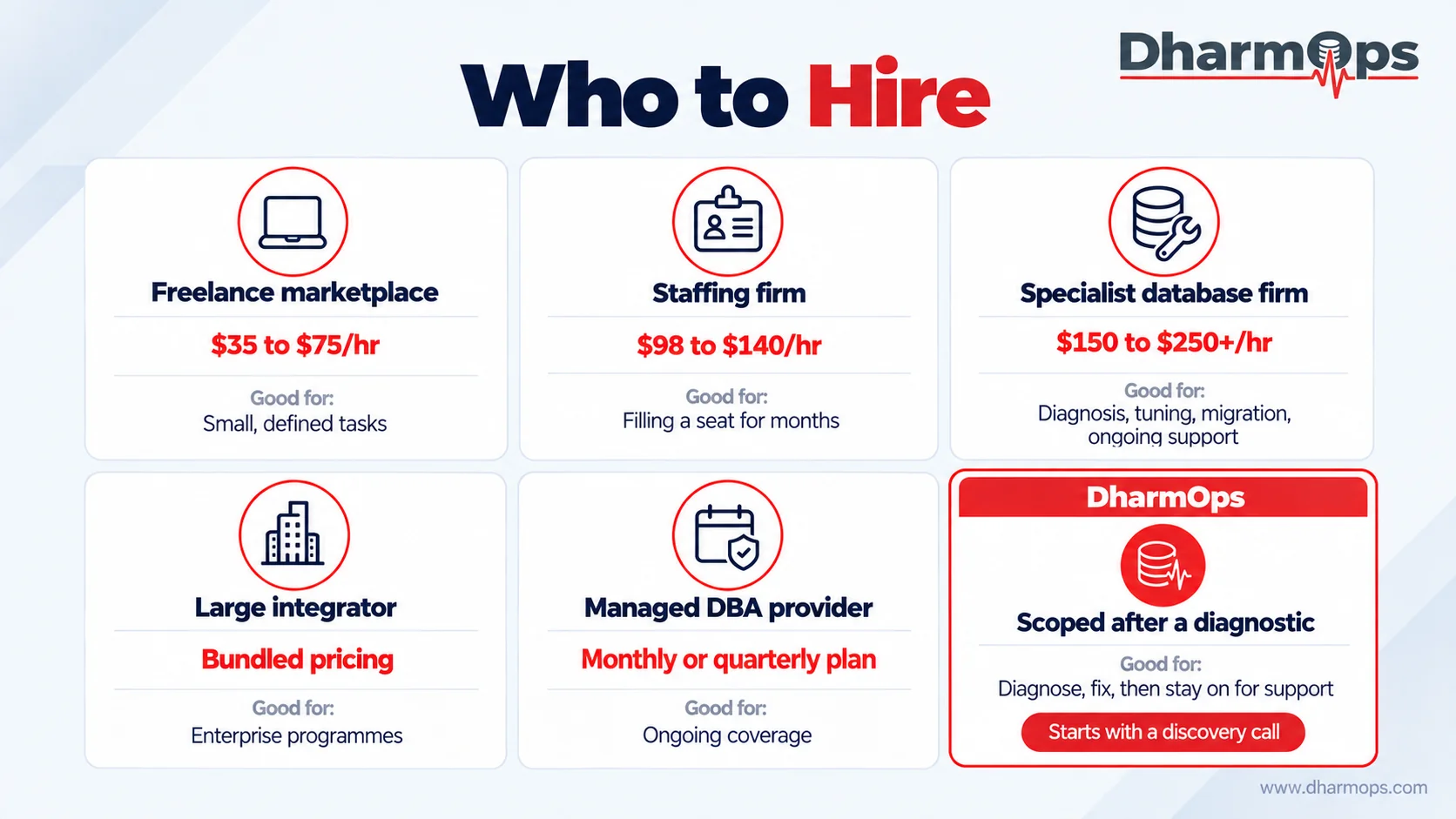
Where DharmOps fits: a specialist database firm that covers the diagnosis, the fix and the support after it. You don't hire three providers for one problem.
When a full-time hire makes more sense
Sometimes the answer is a person, not a provider. If database work fills most of someone's week, every week, a full-time hire can make sense.
Budget for more than the salary. The Bureau of Labor Statistics puts median pay at $104,620 for database administrators and $139,500 for database architects (May 2025). Payroll taxes, benefits, recruiting and the months it takes to fill the role all sit on top. Our managed DBA vs hiring in-house guide runs the full numbers.
Related: database engineering services
Get a Straight Answer Before You Sign
Tell us what your database is doing. We'll tell you what's likely causing it and what it should take to fix, before anyone quotes you.
Book a Discovery CallMistakes that make database consulting cost more
Picking on hourly rate alone
The lowest rate often comes with the most hours and the narrowest scope. Compare totals and deliverables instead.
Starting a migration without a diagnostic
Migration quotes on an unknown system carry the biggest risk buffers. A diagnostic first turns that buffer into a scoped plan.
Buying a commitment discount before right-sizing
A one-year Savings Plan on an oversized instance locks in the waste. Right-size first, then commit.
No handover, so the same problem comes back
If the fix lives only in the consultant's head, you'll pay to rediscover it. Make documentation a named deliverable.
Scoping from the symptom instead of the cause
"Make it faster" invites a quick index and a quick invoice. "Find out why p95 tripled" gets you the cause.
What to do before you request a quote
- Write your one-sentence problem statement, with the symptom and the business impact.
- Pull three numbers: p95 query latency, monthly database spend and incident count last quarter.
- Get two quotes and run both through the six-step check.
- Or bring those three numbers to a DharmOps discovery call. We'll tell you what the problem is likely to need before anyone quotes you.
Database consulting quotes differ 5x because they price different things: who does the work, how senior they are, where they sit, your platform, your scope, the type of work, how urgent it is and how ready your side is. The hourly rate is the least useful number on the page. Hours, deliverables and what happens after the fix tell you more.
Getting quotes that don't line up? Bring the quotes and your three numbers. On a discovery call, DharmOps will walk through what each quote covers, what it leaves out, and what your database actually needs.
Book a Discovery CallFrequently Asked Questions
How much does database consulting cost per hour?
In 2026, most US database consulting costs about $90 to $190 an hour. Offshore and marketplace freelancers charge $35 to $86. Senior specialists charge $150 to $250 or more. GSA's federal data puts the median ceiling for database administrators at $129 an hour.
What is a reasonable fee for database consulting?
A reasonable fee is one where the total matches the scope. For US work, $90 to $190 an hour is typical. Check the hours estimate, the deliverables and what's excluded. A higher rate with fewer hours and a wider scope is often the better deal.
What does a database consultant do?
A database consultant finds out why a database is slow, expensive or unreliable, then fixes it. The work covers queries, indexes, schema design, configuration, instance sizing, backups and migrations. Good consultants also document their changes and set up monitoring so the problem doesn't quietly return.
Is hourly or fixed-fee database consulting cheaper?
Neither is cheaper by default. Hourly suits unclear problems, but you carry the risk of overruns. A fixed fee suits clear scope, but the price includes the consultant's risk buffer. A short diagnostic followed by a fixed fee for the fix often costs least overall.
Is a remote DBA cheaper than hiring a full-time DBA?
Usually, unless database work fills a full week. The BLS median pay for a database administrator is $104,620 before taxes, benefits and recruiting. A remote or managed service charges only for the hours or coverage you use, across more platforms than one person usually covers.
Do we still need a DBA if we're on RDS, Aurora or Snowflake?
You need the skills, if not the job title. Managed services handle hardware, patching and backups. Schema design, query tuning, configuration and instance sizing stay with you. Without someone who knows them, teams tend to scale up instead of fixing the cause.
How long does a database migration take?
It depends less on data size than on stored procedures, application code and integrations. A simple migration between similar engines can take weeks. Migrations with heavy procedural code or many connected systems take months. Our database migration cost guide breaks down the phases.
Will AI replace database administrators?
Not in 2026. Redgate found AI use in database management rose from 15% to 44% of organisations in a year, which speeds up routine diagnosis. Design and migration decisions still need judgement. The BLS projects 4% job growth for database administrators and architects from 2025 to 2035.
Get a Straight Answer on Your Setup
Tell us what you're running into. We read every message personally and reply within 24 hours with times for a 30-minute discovery call.