
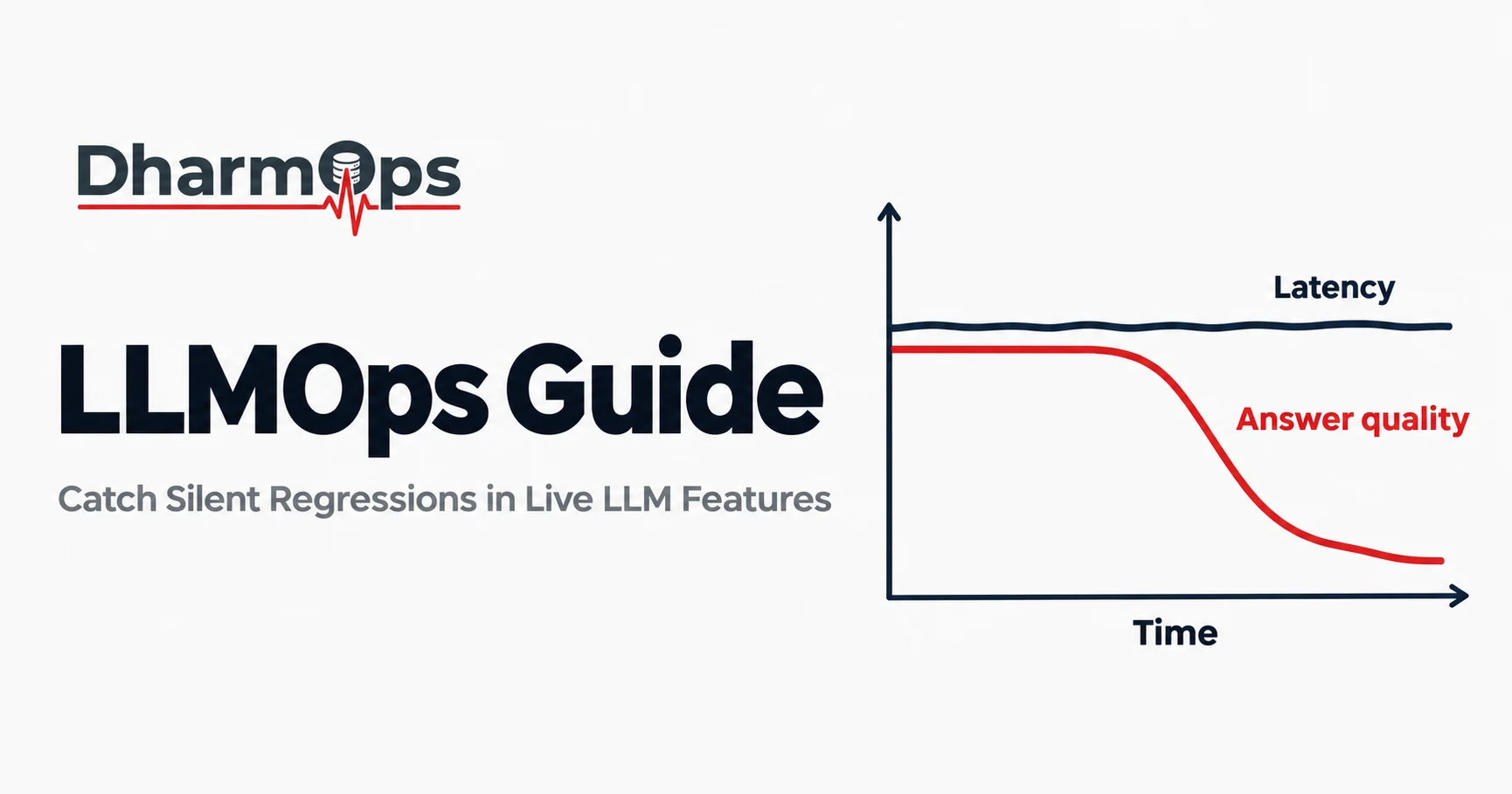
An LLM feature can get worse while every dashboard stays green. Latency holds, errors stay flat, and the answers quietly go wrong. Nothing pages anyone, because nothing failed.
LLMOps is how a team catches that. It's the work of testing, releasing, monitoring and paying for LLM features once real users depend on them.
Investment is still catching up. Gartner put LLM observability investment at 15% of GenAI deployments in March 2026, and predicts 50% by 2028.
The model underneath you also has an end date. Anthropic gives at least 60 days' notice before it retires a model, and OpenAI shuts down its dated gpt-4o snapshots in January 2027. When yours goes, can you prove the replacement won't make answers worse?
Most LLMOps guides won't help you answer that. Many start with training and fine-tuning, which doesn't fit a team calling a model API. Few say who gets paged when the answers are wrong.
This guide starts where they stop. You'll build a test set that catches regressions, gate every prompt and model change, and walk through a model retirement step by step. You'll also get an ownership map, a cost-per-feature calculation and a runbook to copy.
Every figure in this guide links to its source, and we label examples as examples.
Jump to: Release gates · Model retirement example · Incidents · Tools
Only prototyping so far? See when you need LLMOps →
Already facing a retirement date or a regression you can't explain? Book a 30-minute discovery call →
What is LLMOps?
LLMOps is production operations for features built on large language models. This guide assumes that the feature is live or launching within a few months, and that it mostly calls a provider's API. Self-hosting models on GPUs and fine-tuning are separate problems, so they stay out of scope here.
| Job | The question it answers |
|---|---|
| Test | Did this change make answers worse? |
| Release | Can we roll it out gradually and undo it quickly? |
| Observe | What happened on this request, and is quality holding? |
| Control cost | What does this feature cost per customer? |
| Secure | What can a bad input make this feature say or do? |
| Respond | Who acts when the answers are wrong, and how? |
MLOps still matters, but three things change. The prompt becomes a production artifact, the same input can return different outputs, and each call has a direct per-token cost. Teams that call an API often skip training pipelines altogether, and they still need everything in the table.
Why LLM features break differently
Nothing throws an error
A plausible wrong answer returns HTTP 200. Latency and error monitoring can't see it, so the first signal is often a customer or a support ticket.
Damage can also be narrow. At SREcon in 2025, practitioners described quality falling in one small question space while common questions stayed fine (TechTarget). An average score across all traffic can hide that.
The model underneath you changes
Providers publish retirement dates, and the dates arrive whether or not you're ready. These two notices were on the providers' pages when this guide was written:
| Provider | Models | Notice | Shutdown | Gap | Recommended replacement |
|---|---|---|---|---|---|
| Anthropic | Claude Sonnet 4.5 | Sep 30, 2026 | Nov 30, 2026 | 61 days | claude-sonnet-5-5 |
| OpenAI | Dated GPT-4o, GPT-4o mini, GPT-4.1 and GPT-4.1 mini snapshots | Oct 14, 2026 | Jan 14, 2027 | 92 days | gpt-6-luna |
Read the date, not just the policy. OpenAI's page states at least six months for generally available models, unless safety or compliance concerns require less, yet this notice ran about three months. Plan around the shortest window you've actually seen.
Many teams were exposed. In March 2026, GPT-4o had 22% adoption and Sonnet 4.5 had 19% among Datadog's LLM customers. One speaker at SREcon compared a model change to swapping the underlying database, which is a useful way to size the risk.
Cost and capacity move with usage
Average tokens per request more than doubled year over year for the median customer in Datadog's report, which covers telemetry from more than 1,000 of its own customers. Rate limits were 60% of LLM errors in February 2026 and almost a third in March. That's one vendor's customer base rather than the whole market, but it shows a failure mode many LLMOps guides skip.
Not every feature needs all of this on day one.
When do you need LLMOps, and how much?
You need some of it as soon as any of these is true:
- Real users act on the answers.
- The feature touches customer data.
- Your bill has moved and nobody can explain why.
- You've received a retirement notice, or your model has a published retirement date.
- More than one person changes prompts.
More teams are reaching this point. In McKinsey's 2026 State of AI survey, 44% of respondents said AI is scaling across their enterprise, up from 38%. That's self-reported and covers AI broadly, but the direction is clear.
Scale the setup to the team. This table is our guidance, not an industry standard:
| Capability | About 3 engineers | About 10 engineers | 30+ engineers |
|---|---|---|---|
| Test set | 50 to 100 cases in the repo, run before each change | Several hundred cases, by segment, run in CI | Per-feature suites with named owners |
| Prompt versioning | Prompts in Git, version logged per request | Production alias and review | Registry with approval and audit trail |
| Tracing | One tool, all requests | Sampled quality scoring, dashboards per feature | Shared OpenTelemetry standard across teams |
| Cost | Feature tag, weekly review | Per-customer view, budget alerts | Team budgets, limits at a gateway |
| On-call | A named person and a kill switch | Quality rota, written runbook | Severity process, post-incident reviews |
| Model retirement | Monthly check of provider pages | Scripted check, candidate tested each quarter | Model inventory with owners |
Whatever the size of the team, the same loop applies.
How LLMOps works: the operating loop
Every change goes through the same cycle. You test it, gate it, roll it out in stages, and watch live traffic. Whatever goes wrong becomes a new test case.
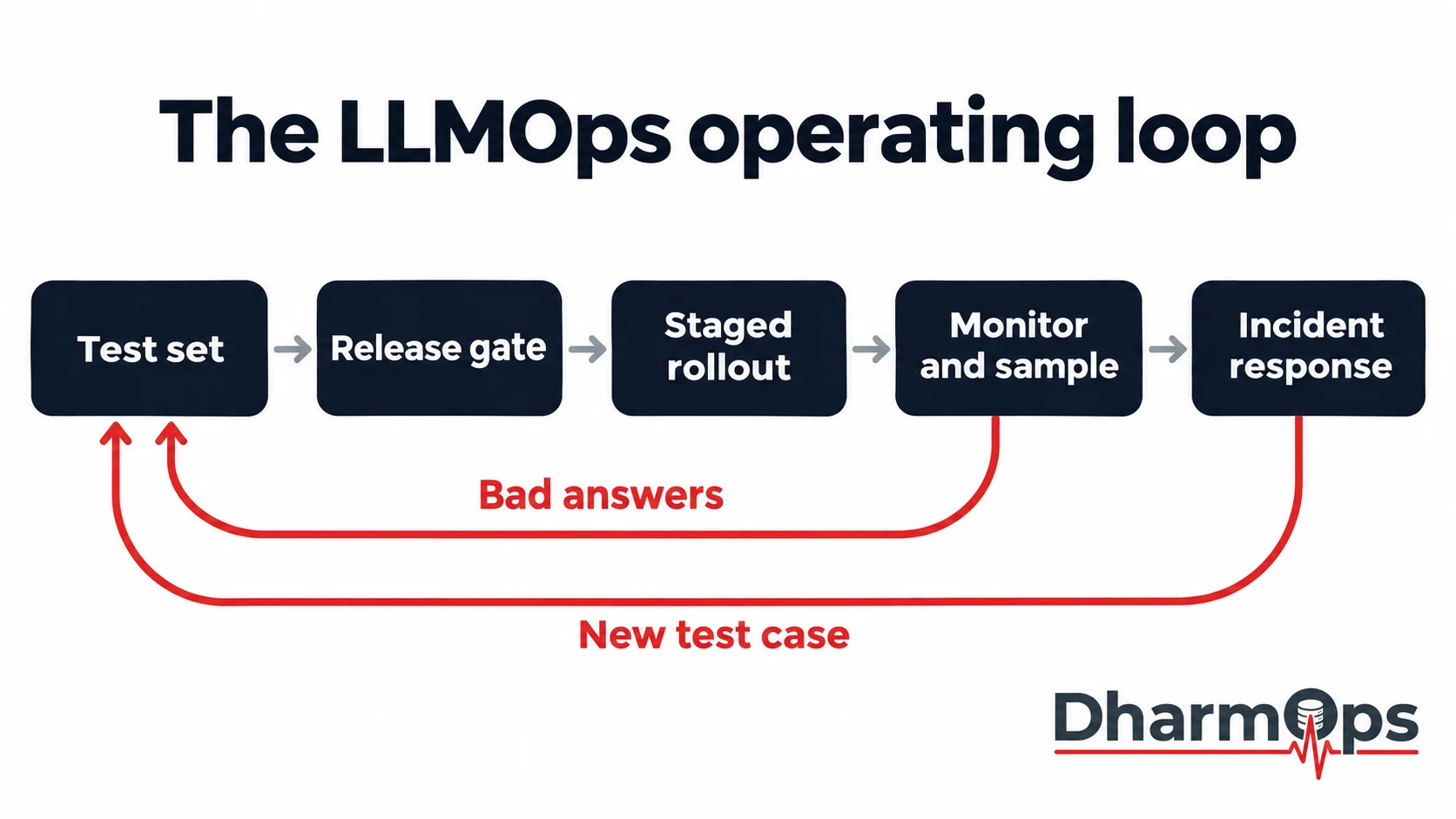
A minimal LLMOps architecture has four parts: prompts and model configuration in version control, an evaluation runner in CI, a gateway or shared client on the request path, and a trace store that sampled scoring reads from. You can start with a small version of each.
A loop with no owners stops at the first incident.
Who owns what when an LLM feature is live
Ownership is the question most teams leave open. At SREcon in 2025, one engineer framed it as "Who can fix it?", and asked whether data scientists should be on call (TechTarget). SREs can shed load on an overloaded database. A hallucination needs someone who can change the prompt or the model.
An ownership map
Use this as a default and change the names to fit your team:
| Job | Owner | Consulted |
|---|---|---|
| Test set and pass marks | AI engineer | Product, domain expert |
| Prompts | AI engineer | Product |
| Model choice and retirements | AI engineer or tech lead | Platform, finance |
| Retrieval and source data | Data engineering | AI engineer |
| Cost per feature | Tech lead | Finance, platform |
| Inputs, outputs and access | Security | AI engineer, legal |
| Infrastructure on-call | Platform or SRE | AI engineer |
| Quality on-call | Feature team | Product, support |
Who gets paged
Split failures by who can fix them.
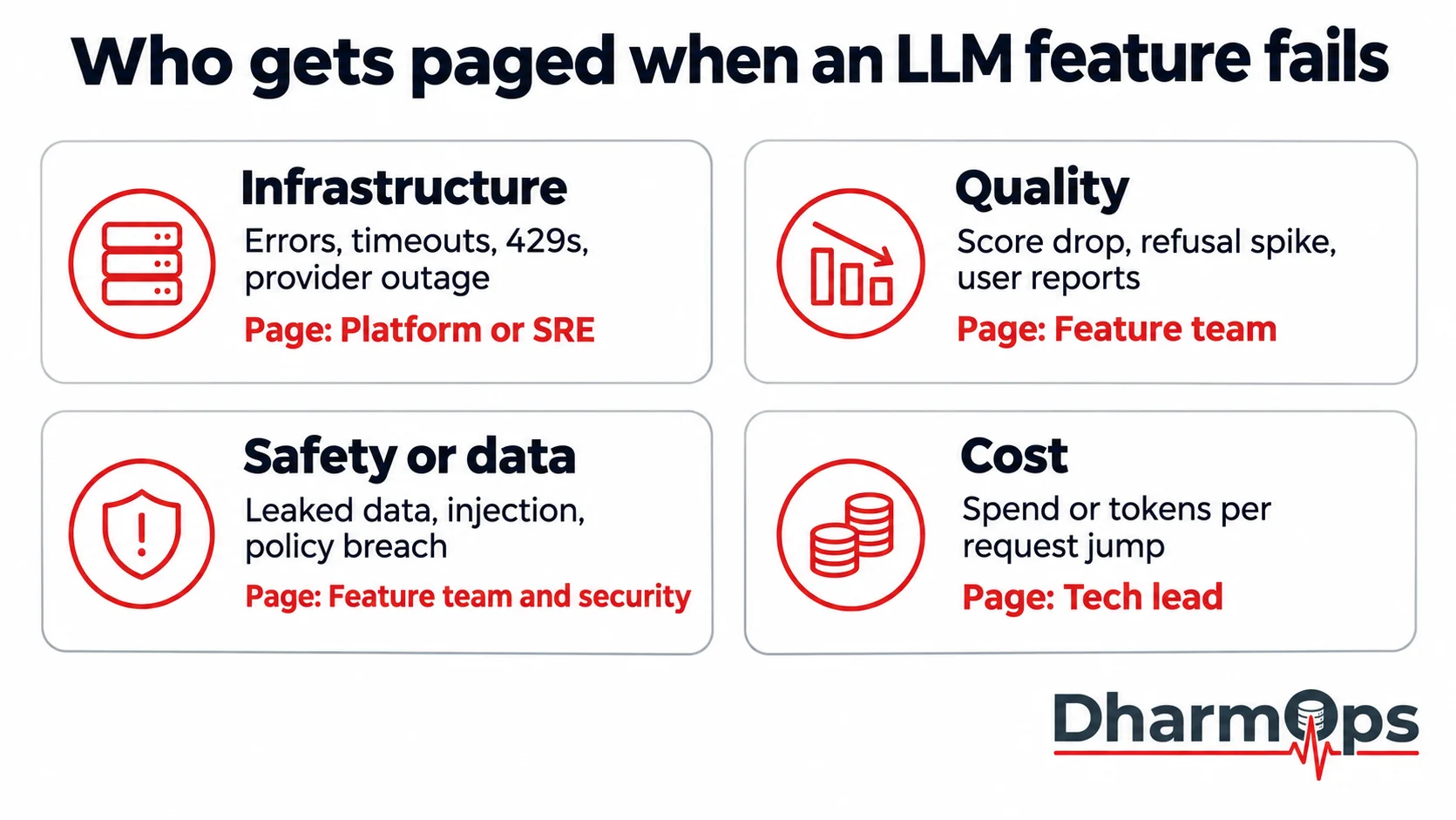
| Failure type | Typical signal | Who gets paged | First action |
|---|---|---|---|
| Infrastructure | Errors, timeouts, 429s, provider outage | Platform or SRE | Fail over, shed load, queue |
| Quality | Score drop, refusal spike, user reports | Feature team | Compare with last good version, roll back |
| Safety or data | Leaked data, injection, policy breach | Feature team and security | Kill switch, preserve evidence |
| Cost | Spend or tokens per request jump | Tech lead, in working hours unless a cap is close | Find the feature and change responsible |
Start with the one thing every later step relies on: a test set.
Step 1: Build a test set that catches regressions
A recurring question in practitioner threads is how to catch regressions after a prompt or model change. The answer starts here. Nothing else in LLMOps can tell you whether a change made answers worse.
What goes in it
Some teams call this a golden dataset. Each case has an input and a way to judge the output, which might be a reference answer, a list of required facts, or a rule. Cover these groups:
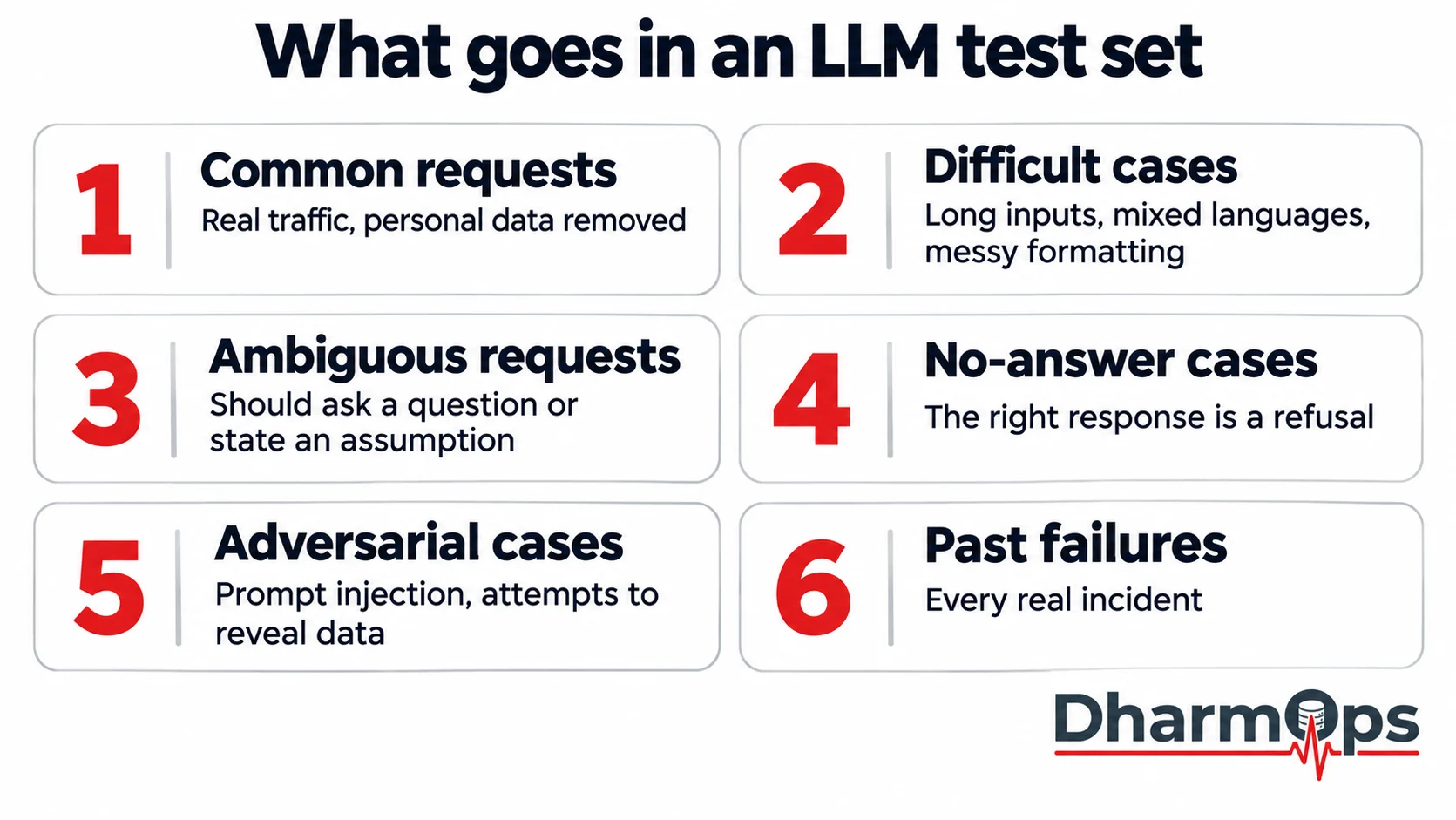
- Common requests: a sample of real production traffic, with personal data removed.
- Difficult cases: long inputs, mixed languages and messy formatting.
- Ambiguous requests: the feature should ask a question or state an assumption.
- No-answer cases: the right response is "I don't know", or a refusal.
- Adversarial cases: prompt injection, attempts to reveal data, and policy violations.
- Past failures: every real incident, which is often the most valuable group.
Tag each case by topic and customer segment, so that a narrow regression shows up in its own score. Start with 50 to 100 cases. A small set that runs on every change beats a large one that nobody maintains.
LLM evaluation metrics that matter
Match LLM evaluation metrics to what the feature does:
| Feature type | Metrics to start with |
|---|---|
| Support or document Q&A | Correctness, groundedness in retrieved sources, refusal rate |
| Extraction | Schema validity, per-field precision and recall |
| Summarization | Coverage of key facts, unsupported claims |
| Classification or routing | Precision and recall per class |
| Writing or coding copilot | Acceptance rate, edits needed, task completion |
Several ranking guides still present BLEU and ROUGE as key metrics. They measure text overlap with a reference, so a correct answer in different words can score low, and a wrong answer with similar wording can score high. They don't tell you whether a support answer is right.
Always add two inexpensive checks: output length and cost per request. Both can shift when a model changes, even if quality holds.
LLM-as-a-judge and human review
Use the cheapest method that gives a reliable result:
- Deterministic checks for schemas, required fields, banned content and citations. Run them on every case.
- LLM-as-a-judge for correctness and groundedness at scale. A judge model is also a model, so pin its version and don't change it during a comparison.
- Human review to calibrate the judge and to settle high-stakes cases. A framework for model migration from Verint researchers calibrates automated metrics against human judgments, so that comparisons hold up with limited manual review.
Setting pass marks
Product and the AI engineer should set pass marks together, because the numbers express what the business will accept. Use two kinds:
- Must-pass cases: injection, data exposure and regulated advice. One failure blocks the release.
- Comparison limits: how far a metric can move from the current production baseline.
Absolute scores matter less than change against the baseline. Watch for noise too. In a set of 200 cases, one case is worth half a point, and outputs vary between runs, so repeat each case a few times before you trust a small move. This test set is the base of your LLM evaluation framework, and it gets its real value when CI runs it automatically.
Step 2: Version prompts and models, and gate every change
Prompt versioning: treat prompts as releases
A prompt edit can change behavior as much as a code change, so give it the same path to production:
- Keep prompts in version control, or in a registry that keeps full history.
- Point production at a named alias, never at "latest", so that promotion is deliberate.
- Log the prompt version, the requested model and the responding model on every request.
- Pin dated model snapshots where your provider offers them, so that the model doesn't change without a decision from you.
Don't assume a provider-hosted prompt store is permanent. OpenAI scheduled its reusable prompt objects and v1/prompts API to shut down on November 30, 2026, and tells users to move that content into application code.
A release gate in CI
Run the gate on any change to a prompt, model setting, retrieval configuration or tool definition. The file below shows the policy to encode. The field names are illustrative, and the numbers are starting points to tune:
# Illustrative release gate. Not a specific tool's schema.
feature: support-assistant
run_when_changed:
  - prompts/support/**
  - config/model.yaml
  - retrieval/**
compare_against: production
test_set: evals/support-golden-v14
repeats_per_case: 3

must_pass_tags: [injection, data_exposure, regulated_advice]

limits:
  correctness:        { minimum: 0.90, max_drop: 0.02 }
  groundedness:       { minimum: 0.92, max_drop: 0.02 }
  refusal_rate:       { max_change: 0.03 }
  p95_output_tokens:  { max_increase_pct: 20 }
  cost_per_request:   { max_increase_pct: 15 }
  any_tag_correctness: { max_drop: 0.05 }   # catches narrow regressions

on_failure: block_merge
override_requires: [feature_owner, product_owner]
The any_tag_correctness limit matters most for silent regressions. It stops a change that holds the overall average but damages one topic.
Roll out in stages
Passing the gate means a change is ready for real traffic, not that it's safe:
- Shadow traffic: send a copy of live requests to the candidate and score the output without showing it to users. Don't execute tool calls that change state.
- Canary: serve 5% of traffic, keeping each customer on the same version. Compare quality samples, refusals and cost.
- Expand: move to 25%, then 100%, as long as each stage holds.
- Rollback: make it a configuration change that takes seconds and needs no deployment.
Here's how those two steps hold up against a real deadline.
Worked example: surviving a model retirement
This scenario is illustrative. The feature and its numbers are invented to show the method, and they aren't a client result.
A support assistant answers billing questions from a help center. Its provider announces that the model will retire in 60 days.
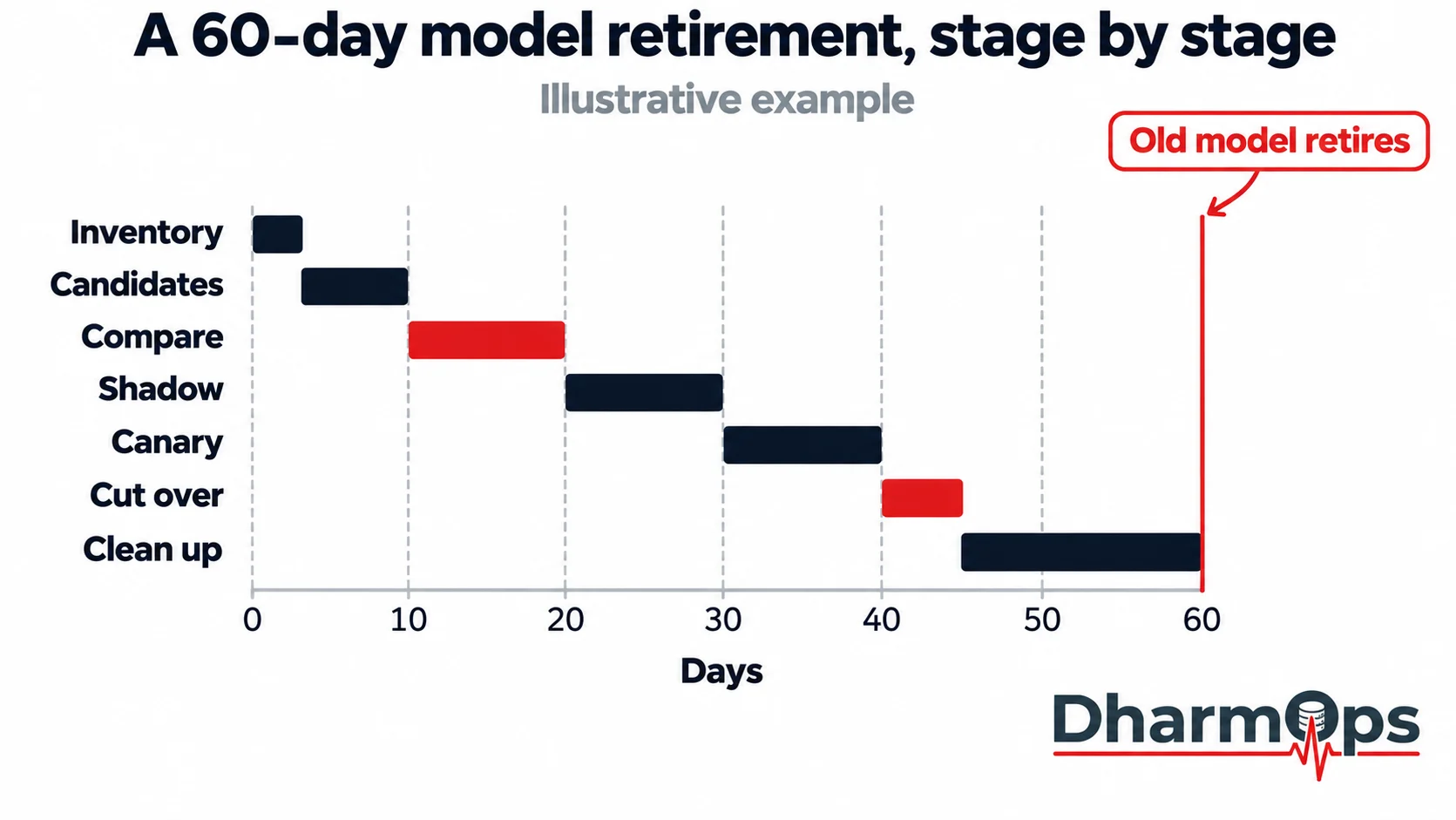
| When | Stage | What the team does | Exit check |
|---|---|---|---|
| Day 0-3 | Inventory | Find every use of the model: code, config, batch jobs, fine-tunes, eval judges | Complete list, one owner |
| Day 3-10 | Candidates | Choose the recommended replacement and one alternative, read their parameter and pricing changes | Both run in staging |
| Day 10-20 | Compare | Run the test set against both, and tune the prompt where needed | Gate passes on one |
| Day 20-30 | Shadow | Score a sample of live traffic without showing it to users | No new failure pattern |
| Day 30-40 | Canary | Serve 5%, then 25% | Quality, refusals and cost hold |
| Day 40-45 | Cut over | Move to 100%, and keep the second candidate ready | One week of stable monitoring |
| Before Day 60 | Clean up | Remove the old model ID and update the runbook | Nothing calls the old ID |
The first comparison is where the value shows up:
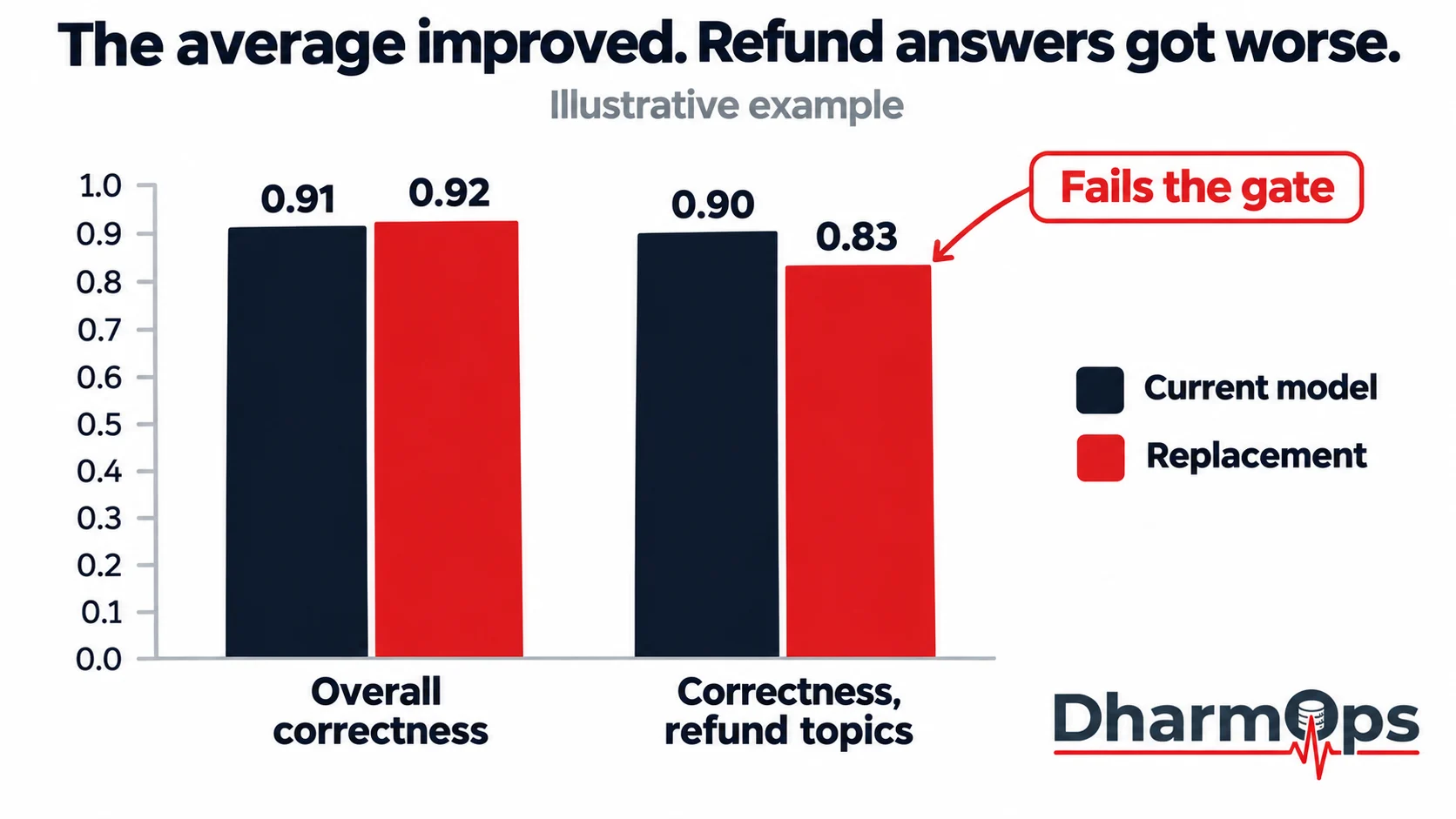
| Metric | Current model | Replacement, first run | Gate | Replacement after prompt fix |
|---|---|---|---|---|
| Correctness | 0.91 | 0.92 | Pass | 0.92 |
| Refusal rate | 4% | 8% | Fail | 5% |
| p95 output tokens | 410 | 590 | Fail | 450 |
| Cost per request | $0.0135 | $0.0150 | Pass | $0.0138 |
| Correctness, refund topics | 0.90 | 0.83 | Fail | 0.89 |
On overall correctness alone, the replacement looks better. The team would have shipped a model that refuses twice as often, writes longer answers, and gets worse at refunds. So ask what changed for your users, along with whether the new model scores well.
Three lessons apply to any retirement:
- Measure more than correctness. Verint's production migration framework, demonstrated on a question-answering system with 5.3M monthly interactions, evaluated correctness, refusal behavior and stylistic adherence.
- Your rollback target changes. After the retirement date, the old model no longer exists. A rollback needs a second tested candidate, which is why the team keeps one ready.
- Automate the warning. OpenAI's List Models endpoint exposes an optional
shutdown_datefield. For other providers, check the deprecation page on a schedule. If you reach a model through a cloud platform, check that platform's own dates, as they can differ.
Facing a retirement date without a regression suite?
We can review your test coverage, rollout path and fallback model. Start with a 30-minute discovery call.
Book a Discovery CallTests catch what you predicted. Live traffic shows you the rest.
Step 3: LLM monitoring and observability
Traces show what happened, evals show whether it was right
LLM observability lets you reconstruct a single request: the prompt version, retrieved context, model, tokens, tools and output. LLM monitoring watches aggregate signals over time and alerts on them. Neither one tells you if an answer was correct. That takes evaluation on a sample of live traffic.
This differs from data observability, which watches pipelines and tables. You may need both, because a stale pipeline can feed bad context into a healthy-looking model.
How to monitor an LLM in production: the signals to watch
Alert on change from your own baseline. The conditions below are examples to tune:
| Signal | What it catches | Example alert |
|---|---|---|
| Schema compliance | Broken structured output | Below 99% for 15 minutes |
| Refusal rate | Model or prompt behavior change | Up 3 points on baseline |
| Output length | Style or model shift, and cost growth | p95 up 20% |
| Sampled quality score | Silent regressions | Down 3 points, overall or in any topic |
| User feedback and escalations | Harm that evals missed | Twice the weekly rate |
| Time to first token | Slowness users notice | p95 up 50% |
| Error and 429 rate | Capacity and provider trouble | Above baseline for 5 minutes |
| Cost per request | Prompt bloat or routing errors | Up 15% day over day |
| Responding model ID | An unplanned model change | Any value not in the allowed list |
Sampling live traffic
You can't score everything economically, so sample with intent:
- Random sample: a small share of all traffic, such as 1% to 5%, for an unbiased trend.
- Targeted sample: all requests with negative feedback, guardrail hits, or a human handoff.
- Per-topic minimum: a floor for each important topic or high-value customer, so that small segments can't hide in the average.
Send confirmed failures back into the test set each week. That's what keeps yesterday's incident from returning. Apply the same data handling to traces as to production data: redact personal data, set retention, and restrict access.
Trace anatomy and OpenTelemetry
Trace one request as nested spans:
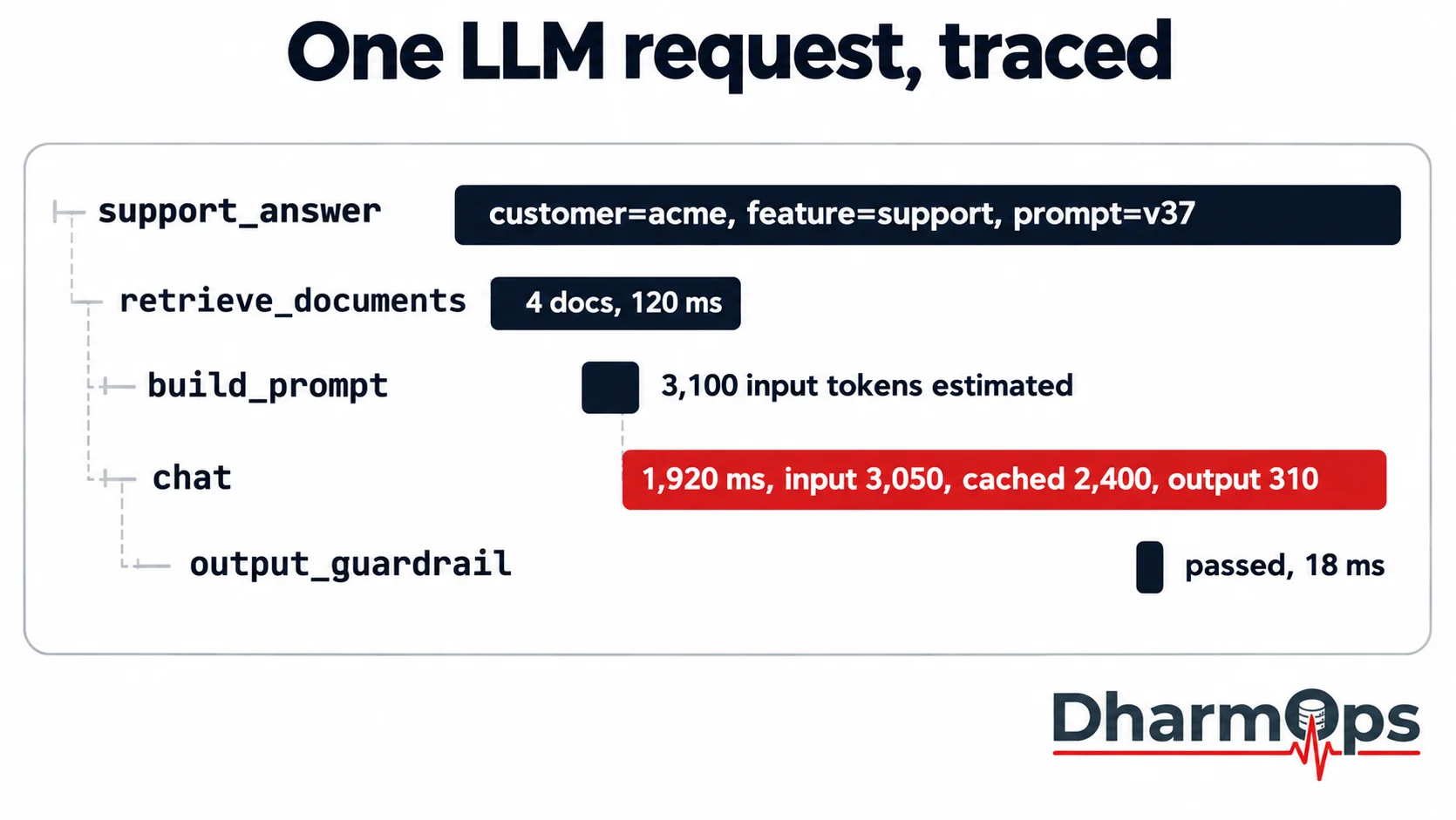
support_answer                 customer=acme  feature=support  prompt=v37
├─ retrieve_documents          4 docs  index=help-2026-11  120 ms
├─ build_prompt                3,100 input tokens estimated
├─ chat <requested model>      response model recorded  1,920 ms
│    input 3,050  cached 2,400  output 310  estimated cost recorded
└─ output_guardrail            passed  18 ms
OpenTelemetry's GenAI semantic conventions give you shared names, including gen_ai.request.model, gen_ai.response.model, gen_ai.usage.input_tokens and gen_ai.usage.output_tokens. Add your own attributes for feature, customer and prompt version.
One caution: the conventions are still marked Development, and names have changed before. For example, prompt_tokens became input_tokens. Keep a mapping layer between your emitters and dashboards, so that a rename doesn't silently break cost reporting.
Step 4: Keep retrieval quality from drifting
If your feature uses RAG, then new embeddings, chunking rules, ranking settings or source documents are all releases. Run them through the same gate.
Test retrieval apart from the answer. If the right document never reached the model, prompt changes won't fix it. Track whether expected documents appear in the top results, and whether the answer stays grounded in what was retrieved. Also watch index freshness, because a broken sync can look exactly like a model regression.
If retrieval is your weak point, compare approaches in our guide to GraphRAG, vector RAG and SQL retrieval and our pgvector vs Pinecone comparison.
Step 5: LLM cost optimization and capacity
Calculate cost per feature and customer
Total spend doesn't tell you where to act. The method has three steps:
- Tag at request time with the feature, customer, prompt version and model.
- Compute from token logs, using a price table with effective dates, because prices change.
- Reconcile to the invoice each month. If the numbers diverge, your tagging or price table is wrong.
An illustrative calculation, at $3 per million input tokens and $15 per million output tokens:
| Item | Tokens | Cost |
|---|---|---|
| Input | 2,000 | $0.0060 |
| Output | 500 | $0.0075 |
| One request | $0.0135 | |
| 40,000 requests a month | $540 |
To estimate cost before shipping, run your test set, take the token counts, and multiply by expected volume. Add a margin for retries and for longer real-world conversations.
-- Illustrative. Assumes input_tokens excludes cached tokens.
SELECT
  r.feature,
  r.customer_id,
  SUM(r.input_tokens        * p.input_per_mtok  / 1e6
    + r.cached_input_tokens * p.cached_per_mtok / 1e6
    + r.output_tokens       * p.output_per_mtok / 1e6) AS cost_usd
FROM llm_requests r
JOIN model_prices p
  ON r.response_model = p.model
 AND r.created_at >= p.valid_from
 AND (p.valid_to IS NULL OR r.created_at < p.valid_to)
WHERE r.created_at >= DATE '2026-10-01'
  AND r.created_at <  DATE '2026-11-01'
GROUP BY r.feature, r.customer_id
ORDER BY cost_usd DESC;
Providers report cached tokens differently, so check whether cached tokens are already inside the input count. A mistake here quietly double-counts spend.
Levers that lower the bill
In order of effort:
- Prompt caching. In Datadog's data, system prompts made up 69% of input tokens in March 2026, yet only 28% of LLM call spans on models that support caching showed cached-read tokens. Keep the stable content at the start of the prompt. Anthropic charges 0.1 times the base input rate for a cache read and 1.25 times for a five-minute cache write. In the example above, reading 1,500 of the 2,000 input tokens from cache would cut the request to about $0.0095, before write costs.
- Shorter context. Remove tool definitions, documents and history that the request doesn't use.
- Output limits. Set them per feature, and ask for concise formats where they fit.
- Routing to smaller models. Send simple requests to a cheaper model. Each route is a release, so run it through the gate.
For a wider view of agent infrastructure spend, see the hidden infrastructure cost of enterprise AI agents.
Rate limits and spend caps
Providers limit requests and tokens per minute, and exceeding a limit returns HTTP 429. Not every 429 should be retried. On the Claude API, a normal rate limit includes a retry-after header. A monthly spend cap also returns a 429, but without retry-after, so every retry keeps failing until access resumes. Handle errors in this order:
- Read the error code before you retry.
- If the error is about spend or quota, stop retrying and alert a person.
- If it's a rate limit, honor
retry-after, then back off with jitter. - Queue work that can wait, and reduce traffic to features that can degrade.
- Fail over only to a model that has passed your test set.
That last point gets missed. An untested fallback is an unreviewed release that goes live at the worst possible moment.
What an LLM gateway does
An LLM gateway is a shared layer between your application and providers. It can centralize keys, per-team limits, usage logs, retries and failover. It's useful once several features share providers. It isn't necessary for a single feature, where a thin shared client may be enough.
Step 6: Secure inputs, outputs and access
Prompt injection holds the top spot, as LLM01, in the OWASP LLM Top 10 2026. OWASP's earlier edition said it's unclear whether fool-proof prevention exists, so plan to limit the damage:
- Enforce permissions outside the model. Never rely on a system prompt as a security control, and don't put secrets in it.
- Make retrieval permission-aware. A user should only retrieve documents they're allowed to read.
- Treat outputs as untrusted. Validate and encode them before they reach a browser, database or another system.
- Use guardrails as one layer. In LLMs, guardrails are input and output checks for injection, personal data and policy. They reduce risk, but they don't remove it, and they add latency that you should measure.
- Keep an audit trail. Record prompt version, retrieved document IDs, tool calls and access decisions, and redact personal data.
Keep adversarial cases in your test set, so that a model change can't quietly weaken them. Legal and compliance sign-off stays with your own counsel. For tool access, see our guide to MCP server security, access control and guardrails.
Step 7: Respond to incidents when the answers are wrong
Practitioner write-ups disagree on severity levels and triage order (Tian Pan, Future AGI). Treat what follows as a starting point, and adapt it to your feature.
Decide severity by user harm
A service can be up and still be in a severe incident. Grade severity by what happens to users, not by system health:
| Severity (example) | What it looks like | Response |
|---|---|---|
| SEV1 | Data exposure, unsafe advice, or answers that cause financial or legal harm | Kill switch now, page security and leadership |
| SEV2 | Wrong answers in a common flow, or a major refusal spike | Page quality on-call, roll back within the hour |
| SEV3 | Wrong answers in a narrow topic, with a workaround | Fix in working hours, restrict the topic if needed |
| SEV4 | Style or length drift, without factual harm | Add a test case and schedule the fix |
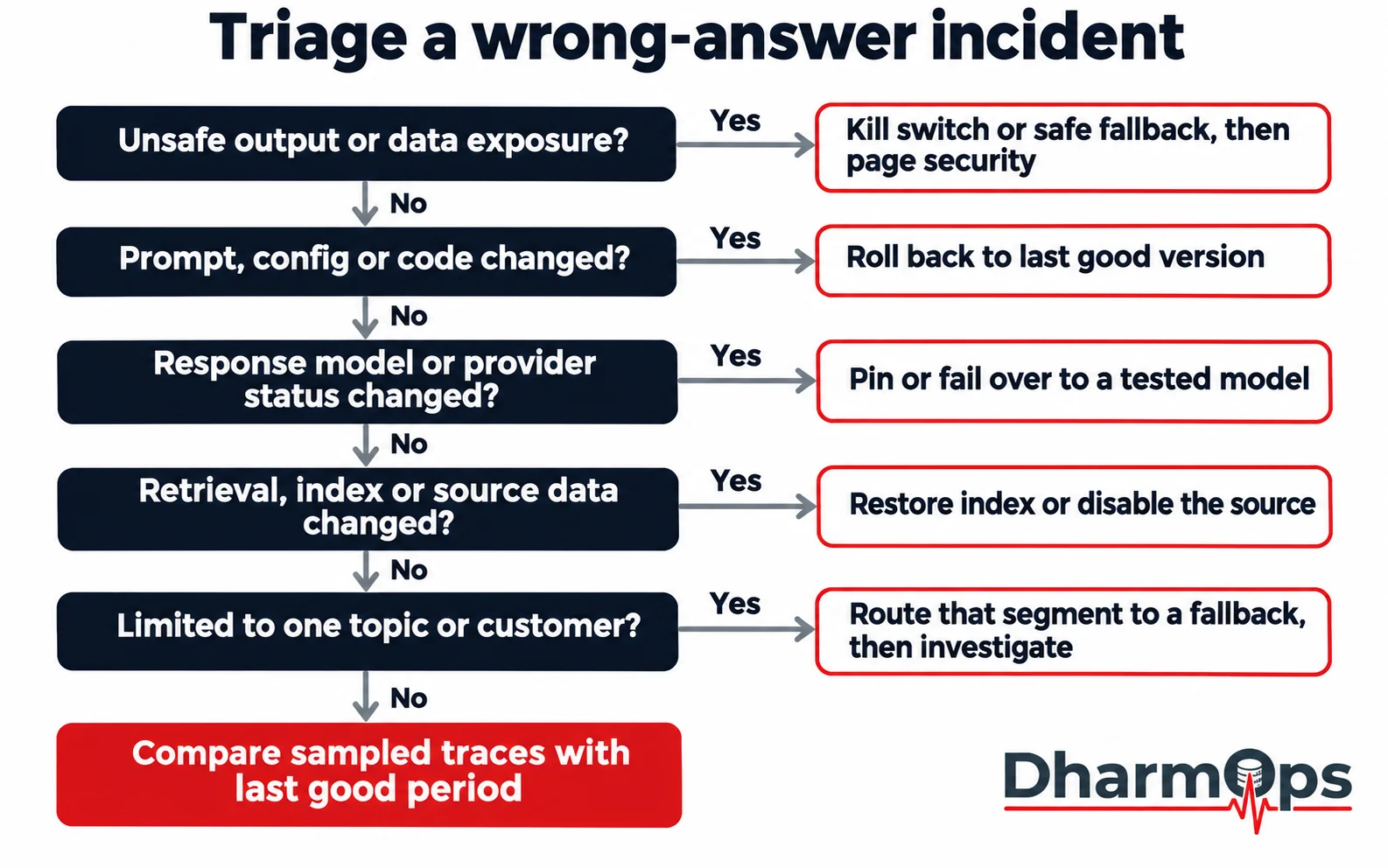
Triage in order
Check containment first. Then check what changed, starting with what you control, because your own changes are quickest to confirm and already have a rollback.
A runbook you can copy
Every control named here has to exist before the incident. Test them during a calm week.
RUNBOOK: <feature> gives wrong or unsafe answers

Owner:            <team>
Quality on-call:  <rota>      Infra on-call: <rota>
Security contact: <name>      Support lead:  <name>
Dashboards:       <quality>   <traces>  <cost>
Provider status:  <url>

CONTROLS
Kill switch:      <flag>      Turns the feature off, shows <fallback message>
Prompt rollback:  <command>   Points the alias to the last good version
Model pin:        <config>    Tested fallback: <model ID>
Source disable:   <flag>      Removes a document source from retrieval

FIRST 15 MINUTES
1. Open an incident channel and assign one lead.
2. Collect 3 to 5 bad examples, with trace IDs.
3. Set severity by user harm. If data is exposed, use the kill switch.
4. Check recent changes: prompt, config, code, model, index, source data.
5. Roll back the most recent likely change. Don't wait for root cause.
6. Confirm recovery using the failing examples and a live sample.

NEXT
7. Tell support what users may have seen and what to say.
8. Preserve traces. Keep access restricted if they include personal data.
9. Find affected requests, so customers can be notified if needed.

AFTERWARDS
10. Add each failing example to the test set, tagged by topic.
11. Check why the gate and monitoring missed it, then change them.
12. Record the owner and date for each follow-up.
Turn every incident into a test case
The incident isn't closed until its failure exists in the test set. This step connects the end of the loop to the beginning, and it's why the test set grows more useful each quarter.
Unsure who gets paged for your feature?
We can help you map ownership, alerts and rollback controls against what you run today.
Book a Discovery CallThe steps stay the same, but the priorities change with the feature.
Real-world use cases: how the setup changes
These are typical patterns, not client stories:
| Scenario | Biggest risk | Main metric | Set up first |
|---|---|---|---|
| Customer support assistant | Confident wrong answers on refunds, policy and account issues | Correctness and groundedness by topic | Test set from real tickets, handoff to a person |
| SaaS copilot inside a product | Cost growth from heavy users, and uneven quality between tenants | Cost per customer, acceptance rate | Per-customer token tracking and limits |
| Document Q&A in a regulated firm | Access control failures and unsupported claims | Citation accuracy, permission failures | Permission-aware retrieval and audit logs |
When the feature becomes an agent
Everything above still applies once a model can take actions, but failures now change things in other systems. Add three controls: a separate identity for each agent, least-privilege permissions on each tool, and human approval for actions that are hard to undo. OWASP lists this risk as Excessive Agency. Before you connect agents to company data, read why your data stack may not be ready for AI agents.
LLMOps tools: what to buy, and how to stay portable
Buy by job, not by logo
Start with the job that's hurting most. Most teams need tracing first and evaluation next, then a gateway once several features share providers. Guardrail tools come in when your risk review calls for them. Buying a platform doesn't produce a test set or an owner, so do those regardless.
Tool comparison
This list covers tools that came up in our research rather than the full market. We don't sell or resell them. Prices and ownership were checked on November 4, 2026, and pricing units differ across vendors, so entry prices aren't directly comparable.
| Tool | Main job | Fits when | Entry pricing | Paid from | License and ownership |
|---|---|---|---|---|---|
| Langfuse | Tracing, evals, prompts | You want open source and a self-host option | Free Hobby tier | $29/month | MIT. Joined ClickHouse in January 2026 |
| LangSmith | Tracing, evals | You're already built on LangChain | $0, 1 seat, 5k traces/month | $39/seat/month | Proprietary. Self-hosting on Enterprise |
| Braintrust | Evals, tracing | Evaluation is the center of your workflow | $0 Starter | $249/month | Proprietary. On-prem or hosted on Enterprise |
| Arize Phoenix | Tracing, evals | You want to self-host and accept a source-available license | Free to self-host | See vendor | Elastic License 2.0 |
| Promptfoo | Testing, red teaming | You want tests in the repo and CI | Open-source CLI | See vendor | MIT. Now part of OpenAI |
| LiteLLM | Gateway, cost tracking | You call several providers | Open source | See vendor | Separate enterprise folder, so check terms for what you deploy |
| Datadog LLM Observability | Monitoring | You already run on Datadog | See vendor | See vendor | Proprietary |
Stay portable
This market moves quickly. In 2026 alone, Langfuse joined ClickHouse and OpenAI announced its Promptfoo deal. OpenAI also scheduled its own Evals platform to shut down on November 30, 2026, pointing users to Promptfoo. These moves don't make any tool a bad choice, but your practices shouldn't depend on a single vendor's roadmap. Four habits help:
- Emit traces with OpenTelemetry where you can.
- Keep test sets and evaluation code in your own repo.
- Export a copy of your traces to storage you control.
- Know what license you'd fork from if you ever had to.
Tools don't prevent the most common mistakes.
Mistakes to avoid
- Buying a platform before you have a test set. You get cleaner charts of a problem that you still can't measure.
- Treating a prompt edit as a config change. It can alter every answer, so it needs a gate and a rollback.
- Monitoring only latency and errors. Both stay healthy while answers get worse.
- Trusting one average quality score. Narrow regressions disappear into it, so score by topic.
- Building the test set once. It goes stale unless real failures keep feeding it.
- Waiting for the retirement notice to test a replacement. Anthropic's minimum notice is 60 days, which leaves little room for a poor first result.
- Keeping an untested fallback. During an outage, it becomes your least-tested release.
- Tracking total spend only. You can't fix a cost that you can't assign to a feature or customer.
- Retrying every 429. Some mean you've hit a spend cap, and retries only add noise.
- Having no kill switch and no named owner. Both feel optional until the first bad afternoon.
Where to start
If you do one thing per week for a month:
- Week 1: Name an owner for quality, list every model ID in use, and check each one's retirement date.
- Week 2: Build 50 test cases from real traffic and past failures, then record your baseline.
- Week 3: Log prompt version, response model, feature and customer on every request, and add a kill switch.
- Week 4: Run the test set in CI on every prompt and model change, then copy the runbook and fill it in.
That won't cover everything in this guide, but it's enough to catch your next silent regression before your users do.
Build, buy or bring in a partner
| Option | Fits when | Watch out for |
|---|---|---|
| Tool only | You have engineers who can set pass marks, own on-call and maintain the test set | A dashboard nobody acts on |
| Hire | LLM features are core to the product, and you'll keep several in production | Hiring takes time, and a retirement date won't wait |
| Partner | You have a deadline or a gap, and want the setup handed to your team | Dependence, so insist on handover and documentation |
You may not need a partner. If one feature is running and your team has time to work through the four weeks above, start there. If the feature matters to revenue and nobody owns quality, outside help can shorten the first pass.
DharmOps AIOps covers LLM features, agents and trained models that you already run in production or will launch within a few months.
Start with a 30-minute discovery call.
Bring the feature, your model's retirement date and your hardest open question.
Book a Discovery CallFrequently asked questions
What does LLMOps stand for?
LLMOps stands for large language model operations. It covers testing, releasing, monitoring, securing and paying for LLM features in production, and responding when they give wrong answers.
What is the difference between LLMOps and MLOps?
MLOps centers on training, deploying and monitoring models that you own. LLMOps often starts with a model someone else runs, so the focus moves to prompts, non-deterministic output quality, per-token cost and provider changes. Many companies need both.
Do I need LLMOps if I only call an API?
Yes. An API removes model hosting, but it doesn't remove regressions, retirements, rate limits, cost attribution, prompt injection or on-call. API-based teams can skip GPU and training work, but they still need the operating loop in this guide.
What are LLM evaluations?
LLM evaluations are repeatable tests of output quality. They run a set of inputs through your feature and score the results with deterministic checks, an LLM judge or human review. Teams run them before release and on samples of live traffic.
How do you detect LLM regressions after a prompt or model change?
Run a versioned test set on the current and proposed versions, and compare quality, refusals, output length and cost, overall and by topic. Block the change if it breaches your limits. Then use shadow traffic and a canary, and score samples of live traffic.
What is LLM observability?
LLM observability is the ability to reconstruct what happened on a request, including the prompt version, retrieved context, model, token counts, tool calls, latency and output. It explains behavior, but judging whether an answer was right takes evaluation.
How do you monitor an LLM in production?
Track errors, latency and rate limits alongside refusal rate, output length, schema compliance, sampled quality scores, user feedback, cost per request and the responding model ID. Alert on change from your baseline, and break quality down by topic.
How do you track LLM costs per user?
Tag every request with feature and customer ID, record input, cached and output tokens, and multiply by a dated price table. Group the results by feature and customer, then reconcile the total against your provider invoice each month.
What should you do when your model is being retired?
Find every use of the model, select the recommended replacement and a second candidate, and run your test set against both. Fix what fails, then move through shadow traffic, canary and full cutover before the date. Keep the second candidate as your rollback.
Who gets paged when an LLM feature gives wrong answers?
Page the feature team, or whoever can change the prompt, model and retrieval setup. Platform or SRE teams usually handle errors and outages, but they often can't fix a wrong answer. Bring in security when data is exposed. Agree on this before launch.
Sources
Checked November 4, 2026, except where noted on the page.
- Anthropic: Model deprecations
- Anthropic: Rate limits
- arXiv 2604.27082: When Your LLM Reaches End-of-Life (Casey et al., Verint, April 2026)
- Datadog: State of AI Engineering (2026; Datadog customers only)
- Datadog: Monitor prompt caching
- Gartner: LLM observability prediction (March 30, 2026)
- Langfuse: Joining ClickHouse
- McKinsey: The State of AI (August 25, 2026)
- OpenAI: Deprecations
- OpenAI: Rate limits
- OpenAI: To acquire Promptfoo (March 9, 2026)
- OpenTelemetry: GenAI semantic conventions
- OWASP: GenAI LLM Top 10 2026
- TechTarget: Site reliability engineers weigh MLOps vs LLMOps (March 2025)
Get a Straight Answer on Your Setup
Tell us what you're running into. We read every message personally and reply within 24 hours with times for a 30-minute discovery call.